Civic Girvan
Stumpy: Girvan’s jail, clock and town hall tower
Key dates
- 1787
The council acquires ground for a market and other town purposes.
- 1825–1827
The surviving tower is built.
- 7 April 1827
The new jail is certified fit to receive prisoners.
- 1837
A prison inspector records the three cells and their conditions.
Show all 8 dates Show fewer dates
- 1860
A separate police station is completed.
- 1911
McMaster Hall opens beside the tower.
- 1939
Fire destroys the hall and the tower’s spire.
- 1957
Stumpy is reported almost restored.
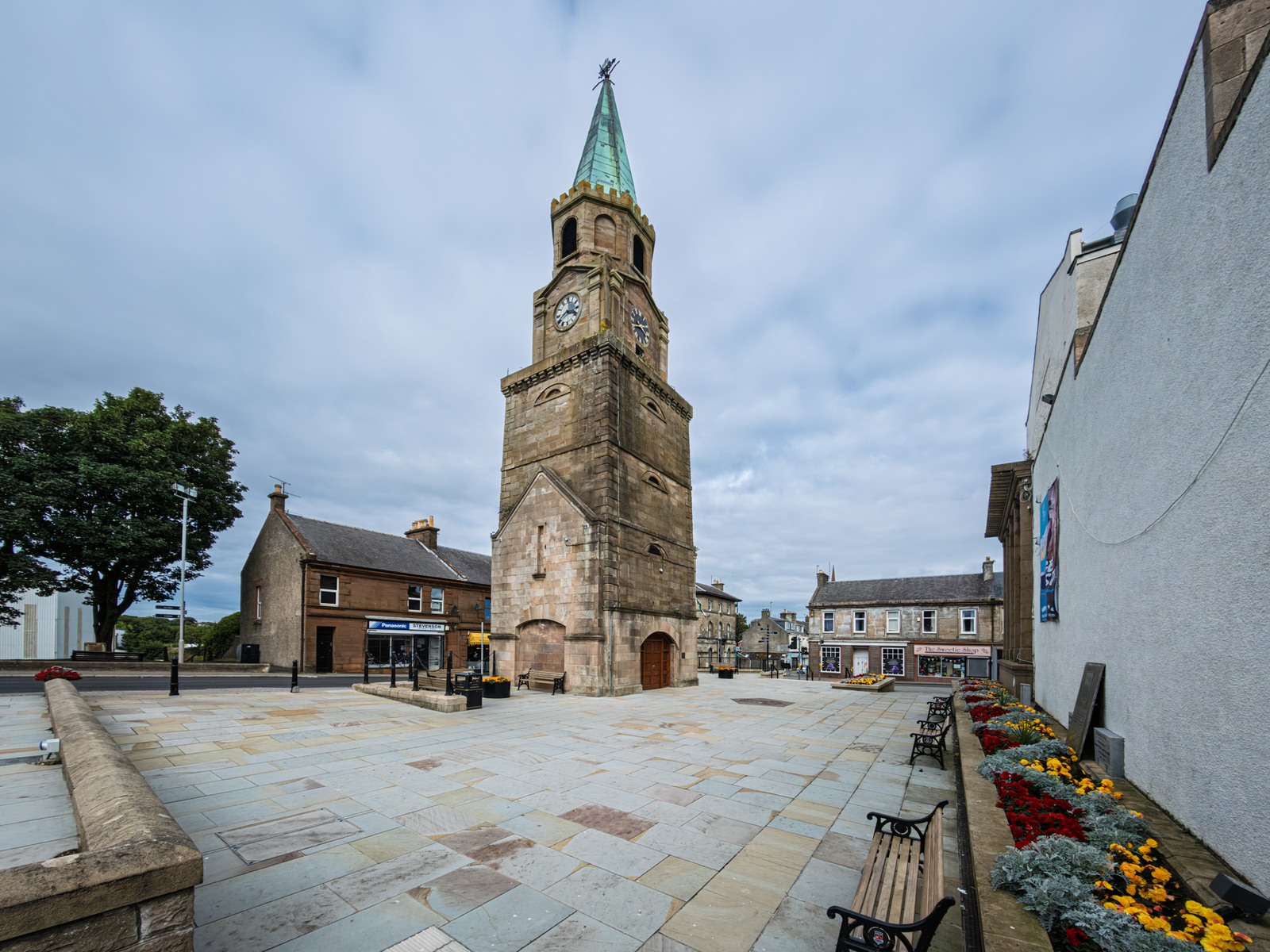
Stumpy’s clock is one of Girvan’s most familiar sights. Inside the tower, a narrow stair leads to three rooms built as prison cells. The jail inspectors’ accounts describe life behind its unglazed windows; the later story includes a gift with a condition that helped keep Stumpy standing.[1], [2], [3]
Before the present tower
Local justice in Carrick long preceded the tower. An account written between 1683 and 1722 describes head courts held in the open air at the hillock of Knock Oshin. Girvan’s burgh foundations also belong to this earlier period: Parliament ratified a charter for a burgh of barony in December 1669, confirming a royal grant made in May 1668.[31], [32]
Girvan Town Council acquired ground at the corner of Knockcushan Street and Dalrymple Street in 1787 for a market and other town purposes. A tolbooth stood on part of the site. In a Scottish town, the tolbooth brought local government and imprisonment into the same building. By about 1820, Girvan’s was ruinous. A market-house with a town hall upstairs followed on the western part of the ground around 1822.[1]
The name Stumpy belonged to an earlier lock-up before it became the familiar name of today’s tower. Writing in 1851, William Howie Wylie recalled the old building and dated its removal to 1828. The name survived in Stumpy Corner and in local speech about being put in Stumpy. Buildings changed, but the association between the place, the name and imprisonment continued.[4]
Roderick Lawson was still making a distinction in 1892. He objected to visitors calling the steeple Stumpy, explaining that the nickname had belonged to a different building and had passed to the nearby “Lazy Corner”. His objection also tells us that people were already applying the old name to the tower.[5] By 1925, the Glasgow Herald was calling the town steeple “Auld Stumpy”.[44]
Building the jail
The present tower was built in 1825–27 beside the town hall. Local contractors Denham, Davidson and McWhinnie carried out the work. The £1,633 total covered both the steeple and three houses on the eastern part of the town’s property. The architect’s identity is unknown.[1]
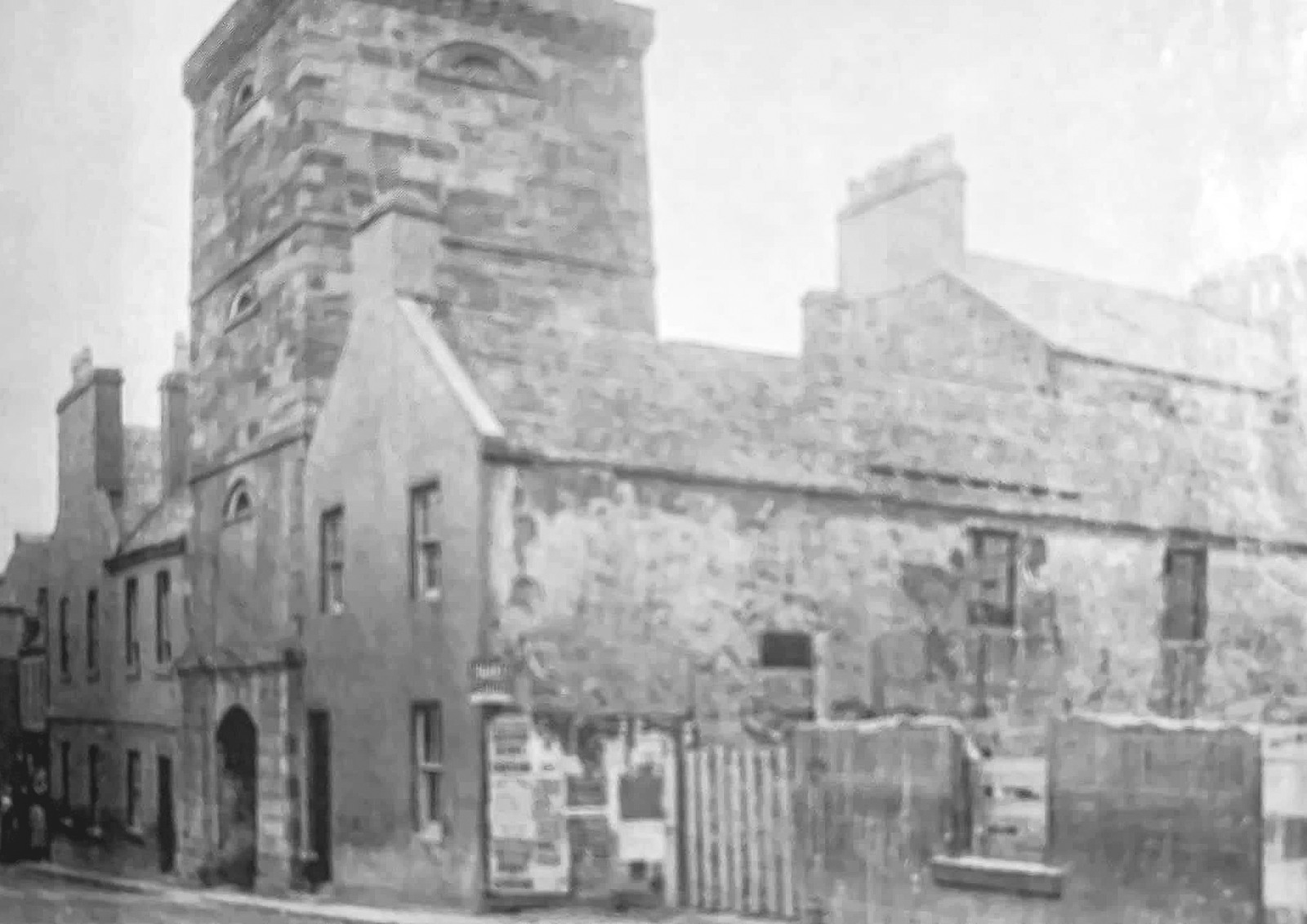
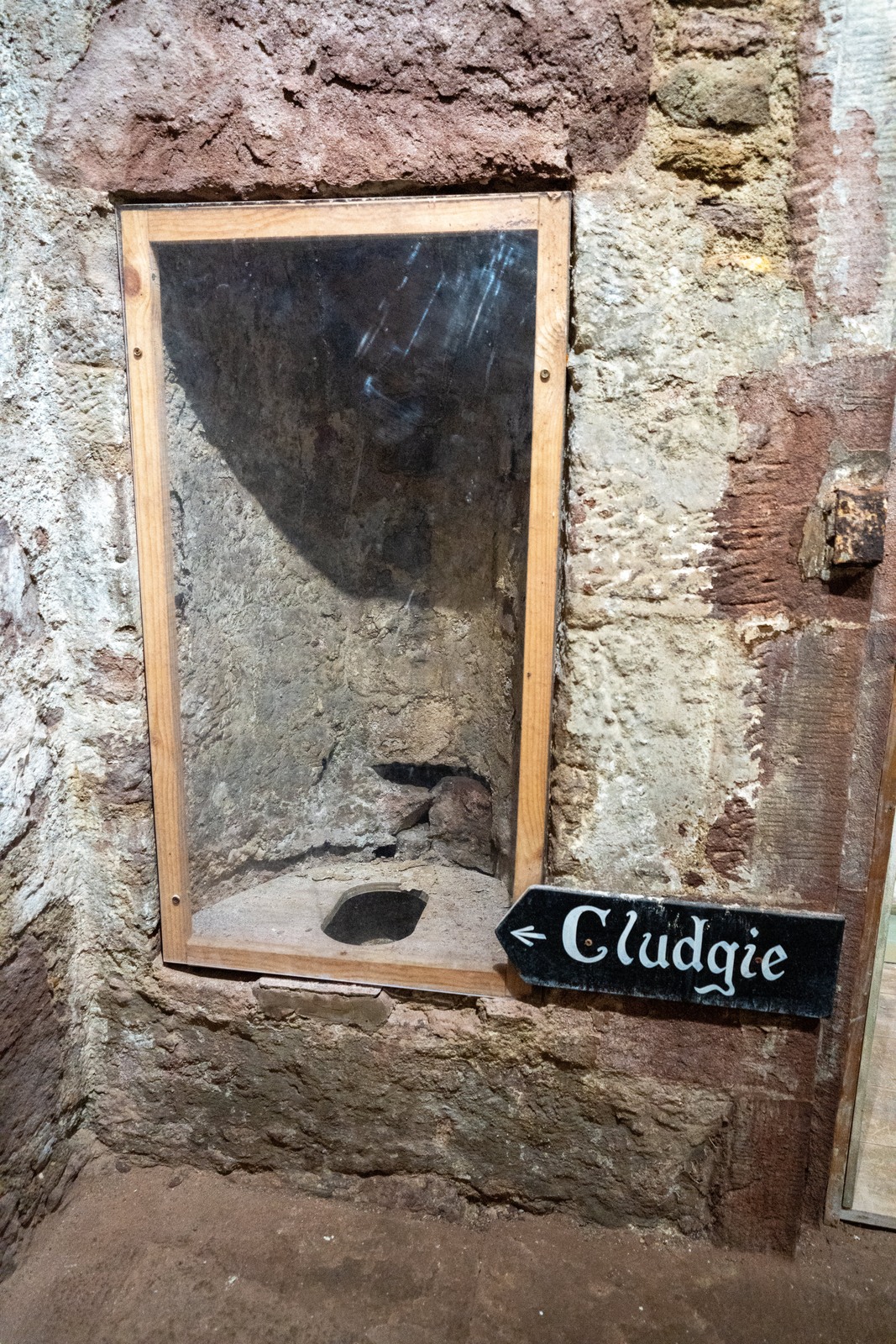
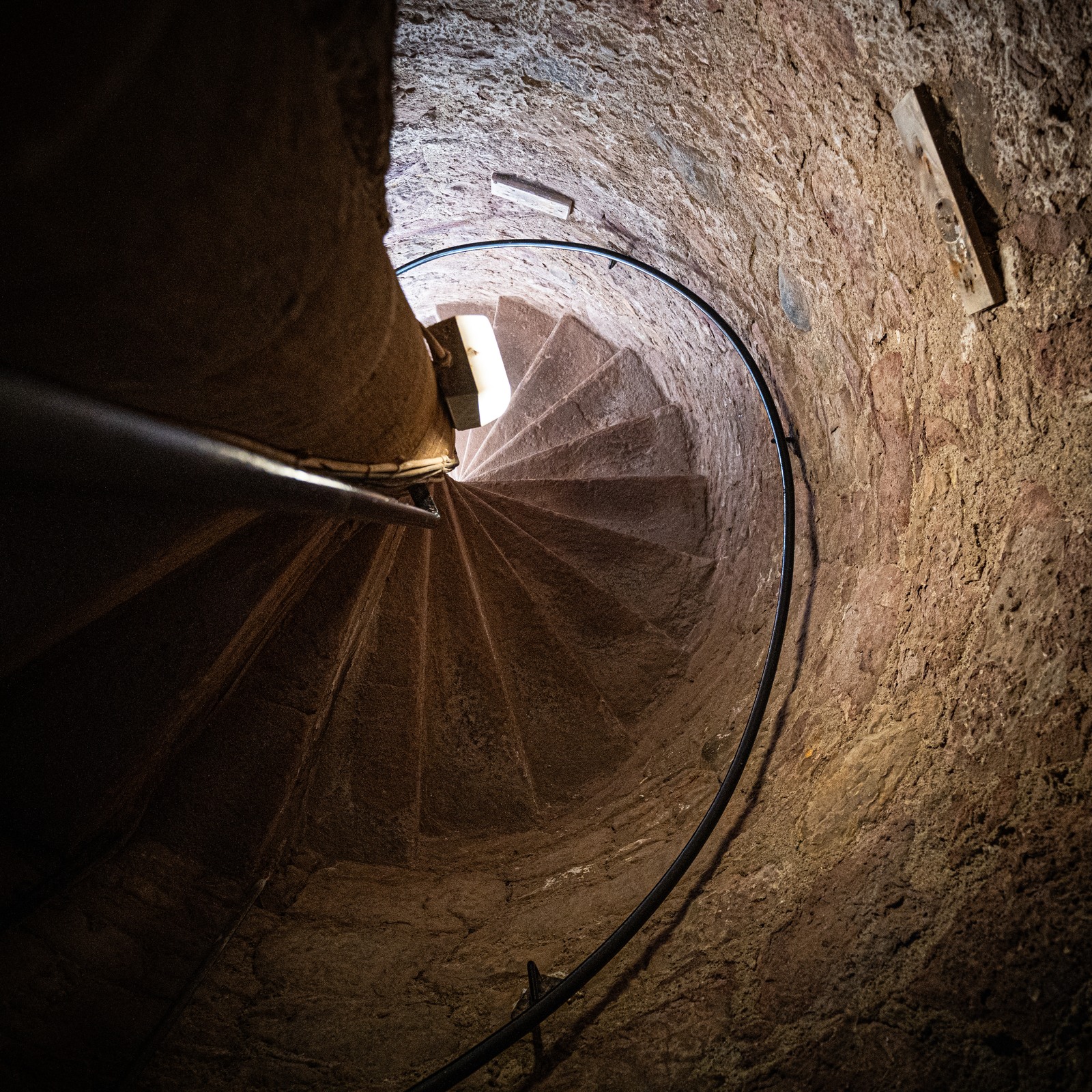
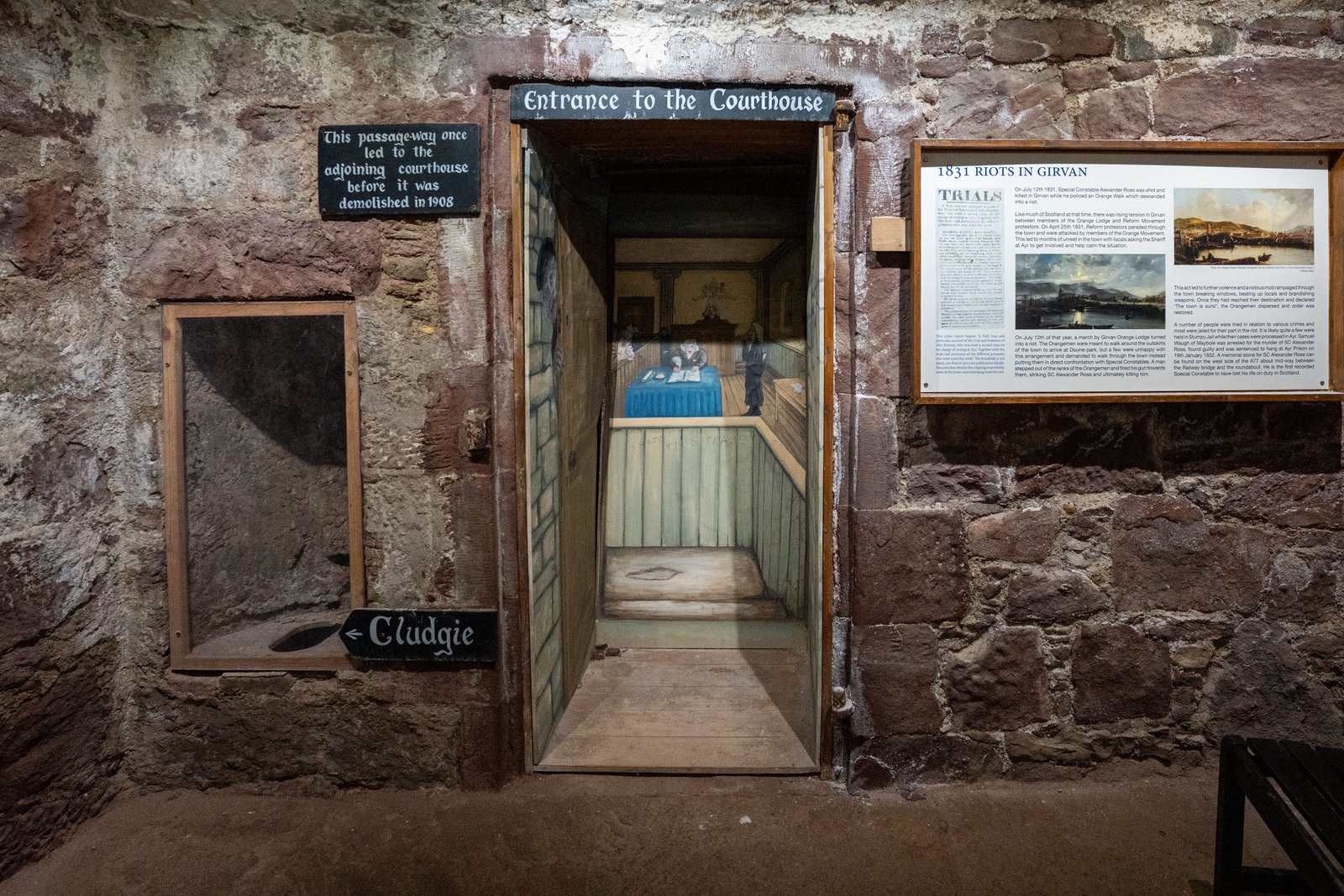
The sandstone tower rose to about twenty-nine metres, with a passage through its ground floor leading to the courtyard behind. Above the passage were three prison floors. The original scheme allowed two cells on each level, but the contractors recommended a change to strengthen the outer walls. The building was completed with one cell on each of the first, second and third floors. Each had a latrine in the south-west corner. A winding stone stair occupied the south-east corner, and curved stone vaults covered the floors below the clock stage.[1], [23]
On 7 April 1827, William Eaton, Sheriff Substitute of Ayrshire, certified that the newly built jail was well aired and fit to accommodate prisoners under the law. A reproduction of his certificate is displayed inside Stumpy.[24]
These cells served a town with its own small court. In the 1830s, Girvan’s bailie court met on Wednesdays in the town hall. A bailie was a local magistrate. The court dealt with civil claims of up to £2 and petty offences carrying fines of no more than £1; failure to pay could lead to imprisonment. Sixty inhabitants were appointed as constables each year and called upon when required.[6]
The Ordnance Survey’s Name Book of the 1850s also describes the town hall as the place where the district’s magistrates held their court. The hall and tower brought the court and cells together on the same site.[25]
Inside the cells
When a prison inspector visited in September 1837, the jail was empty. He found three rooms, one above another, roughly nine feet high. Their lengths ranged from nine to twelve feet and their widths from six and a half to nine feet. The windows had no glass, there was no artificial heating, and prisoners slept on loose straw. One cell was damp and had an offensive privy. The inspector said it should not be used; those he questioned said it was scarcely used already.[2]
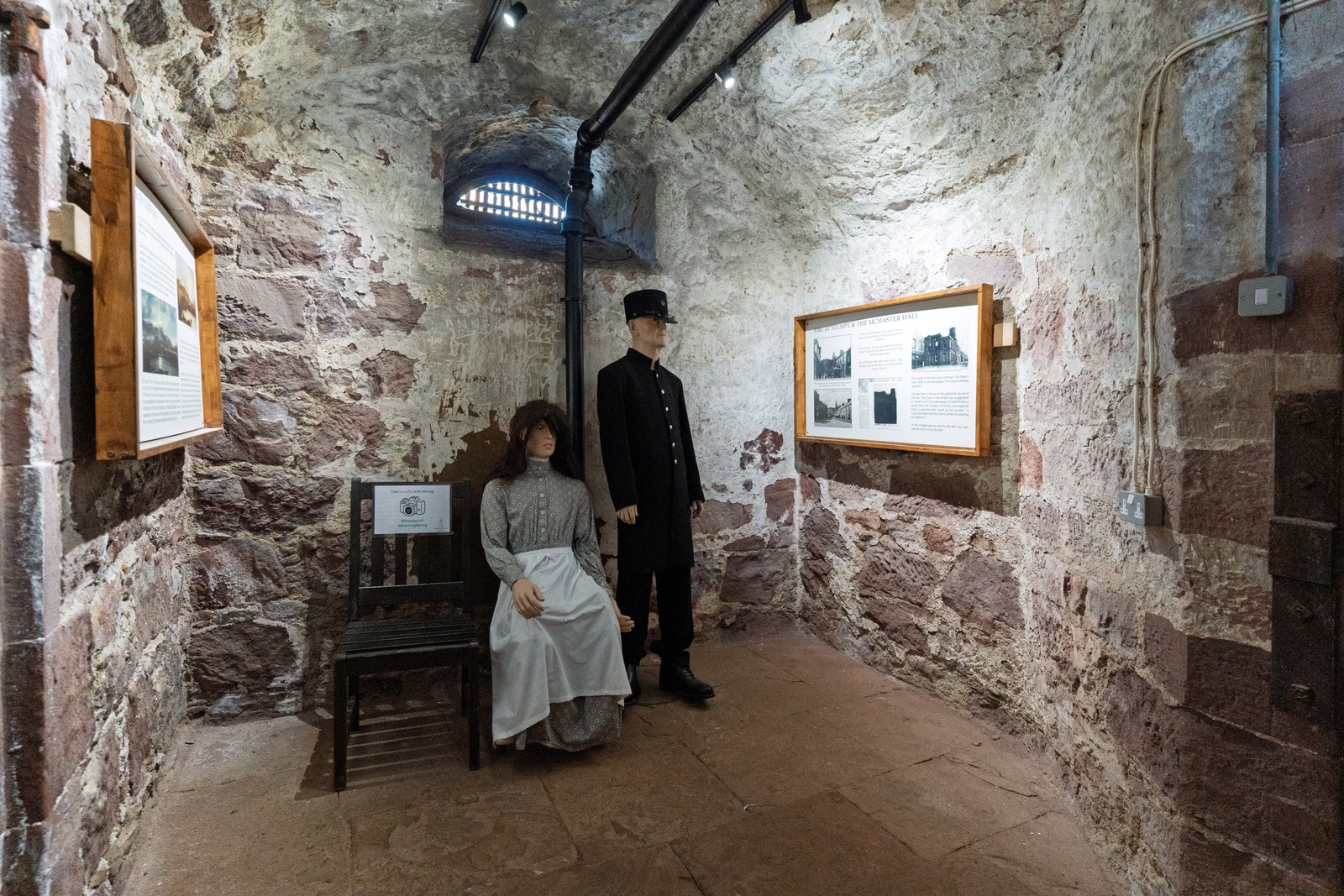
The keeper combined the work with police duties and lived in an adjoining house. Prisoners received fourpence a day for food, supplied as food or money at their choice. The keeper’s payment for looking after the jail was ten shillings and sixpence a year, with a shilling for each admission, separate from his salary as burgh officer.[2]
The inspector was told that twenty to thirty prisoners passed through in a year, generally kept apart. Most were held temporarily, though the magistrates also sent petty offenders there for short sentences. He recorded a local view that the prison had improved the peace of the town.[2]
Keeping the building fit for prisoners proved a continuing problem. In 1842, the General Board of Directors of Prisons approved proposals for repairs at Girvan and Maybole, estimated at £100 between them, and asked for plans and specifications. The following year’s report described new prisons at both places as still under consideration.[7]
Supervision was another concern. During 1843, the County Board proposed renting a house for Girvan’s keeper immediately opposite the prison, twenty feet away. The General Board refused. Its rules required arrangements through which prisoners could reach an officer at any time, whether an officer slept in the prison or another satisfactory system was provided.[7]
On the evening of 25 April 1845, the inspector found two boys in custody. They had been apprehended a few hours earlier; their names and alleged offences are not given. The keeper said the prison was usually empty, and no register was kept. He and the county constable explained that most prisoners were released the next morning or sent to Ayr, with few remaining after examination.[8]
Conditions had changed little. There was still loose straw for bedding, with cobwebs and smells from the privies. The jail had no prison clothing, work for prisoners or surgeon. The keeper was said to be about seventy-five, and the inspector considered him too old for active duty.[8]
The inspector called for glazed windows, warmth, proper bedding and clothing, measures against damp, accommodation for a resident keeper and matron, suitable staff and a surgeon. He recommended limiting detention to ten days. How much of that programme was carried out remains unknown.[8]
The prison and later policing
Girvan was still listed among Ayrshire’s small prisons in the General Board’s report of 1851. In May 1853, a committee recommended discontinuing Girvan and six other small prisons after a new wing had been added to Ayr prison. The exact date when Stumpy’s cells last held prisoners is still unknown.[26], [27]
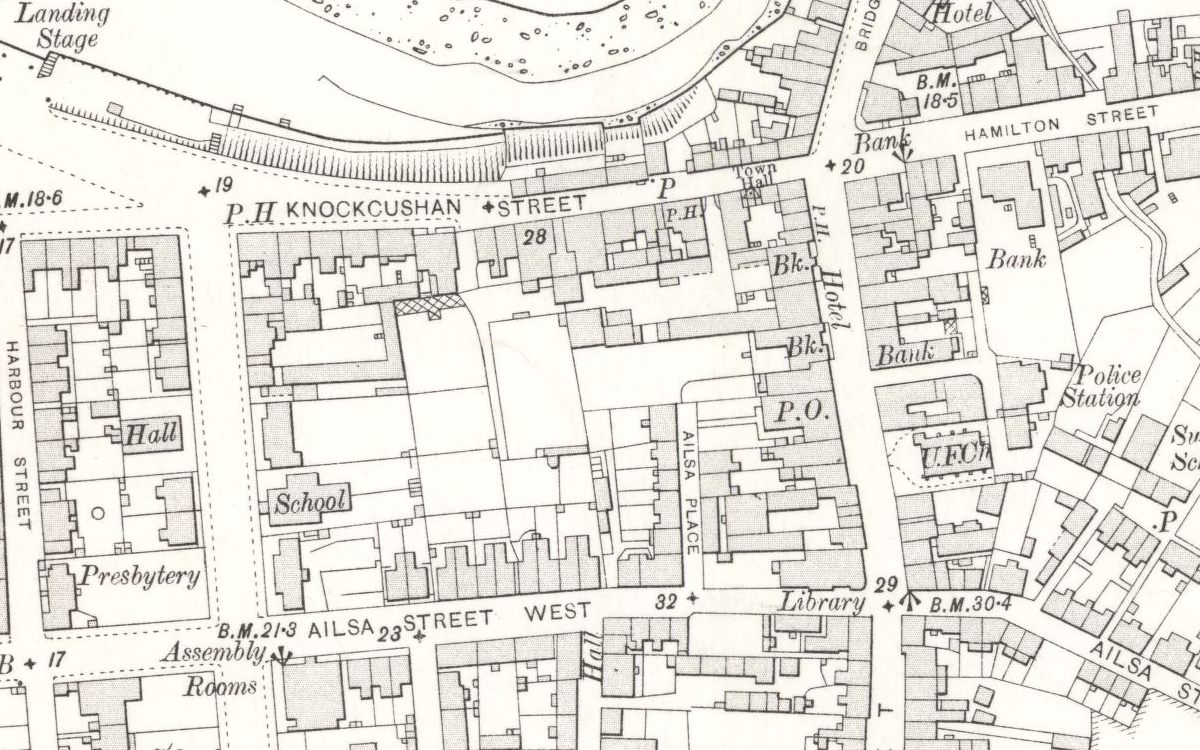
A separate police station was being built in Girvan in 1860. Slater’s directory described work in progress, while the county commissioners’ minute of 30 April recorded the station as completed. A report in 1862 included Girvan among Ayrshire’s new police stations. The Ordnance Survey map published in 1909 shows the station behind the east side of Dalrymple Street, apart from the Town Hall and Stumpy.[28], [29], [45], [30]
Girvan people before the courts
The cases connected with Girvan ranged from public disorder and poaching to forgery and fire-raising. Some of the people involved now appear on Stumpy’s exhibition boards. Their cases can be followed in court indexes and contemporary newspapers, but we have no record placing these named defendants in Stumpy’s cells.
In 1817, before the present tower was built, four men faced charges of rioting and obstructing the export of potatoes from Girvan. A vessel had been compelled to leave without its potato cargo and with little or no ballast. Archibald Smith and Peter Mathews admitted mobbing and received six weeks in Ayr jail. James M’Farlane was dismissed from the case; Edward Johnstone failed to appear and was outlawed.[33]
James Shaw, a Girvan weaver, was convicted in 1828 of passing a forged Bank of Scotland note at Wallacetown. He was sentenced to fourteen years and transported to Tasmania aboard the York in 1829. His colonial record notes a wife and four children in Girvan. It also records his certificate of freedom in 1843.[34], [35]
In April 1833, three Girvan tradesmen pleaded guilty to night poaching: Thomas Young and William Beggs, both weavers, and Andrew Currie, a shoemaker. Each received nine months’ imprisonment. Another board name, James Sinclair, a Girvan flesher, faced a sheep-stealing charge in 1842. His verdict was not proven, and he was discharged.[36], [37]
A fire in High Street led to William McCreadie’s trial in 1862. McCreadie was a grocer and spirit dealer charged with deliberately setting fire to his shop stock to defraud insurers. After a hearing that continued into a second day, the jury found him guilty by a majority, and he received six years’ penal servitude.[38]
The clock and the working town
The bell was cast by Stephen Miller of Glasgow in 1826 and installed the following year. Sir Hew Hamilton of Bargany later gave Girvan its clock. Lawson placed the gift a few years after the tower’s completion and quoted the town records’ description of “an excellent Steeple Clock”.[1], [5]
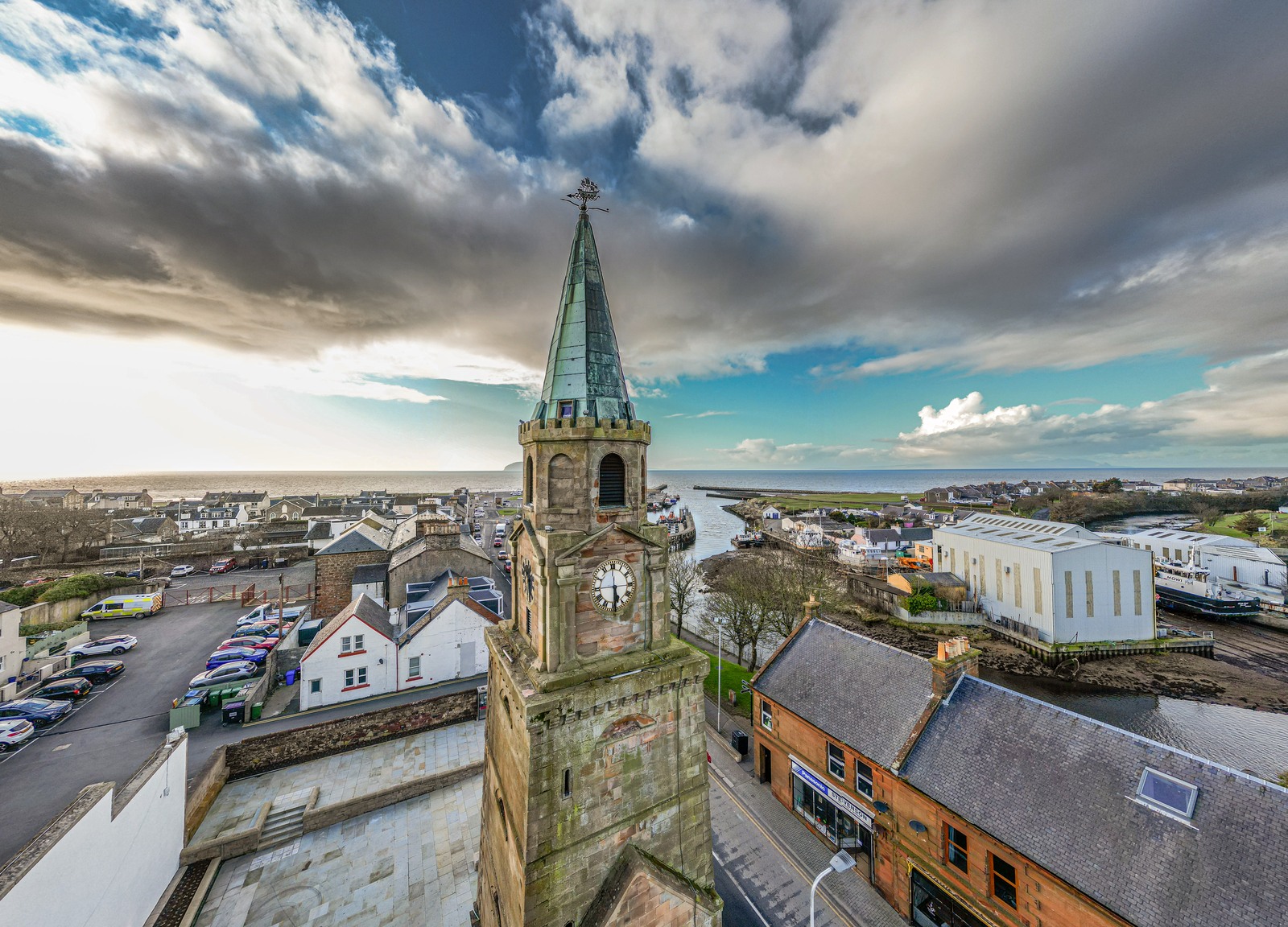
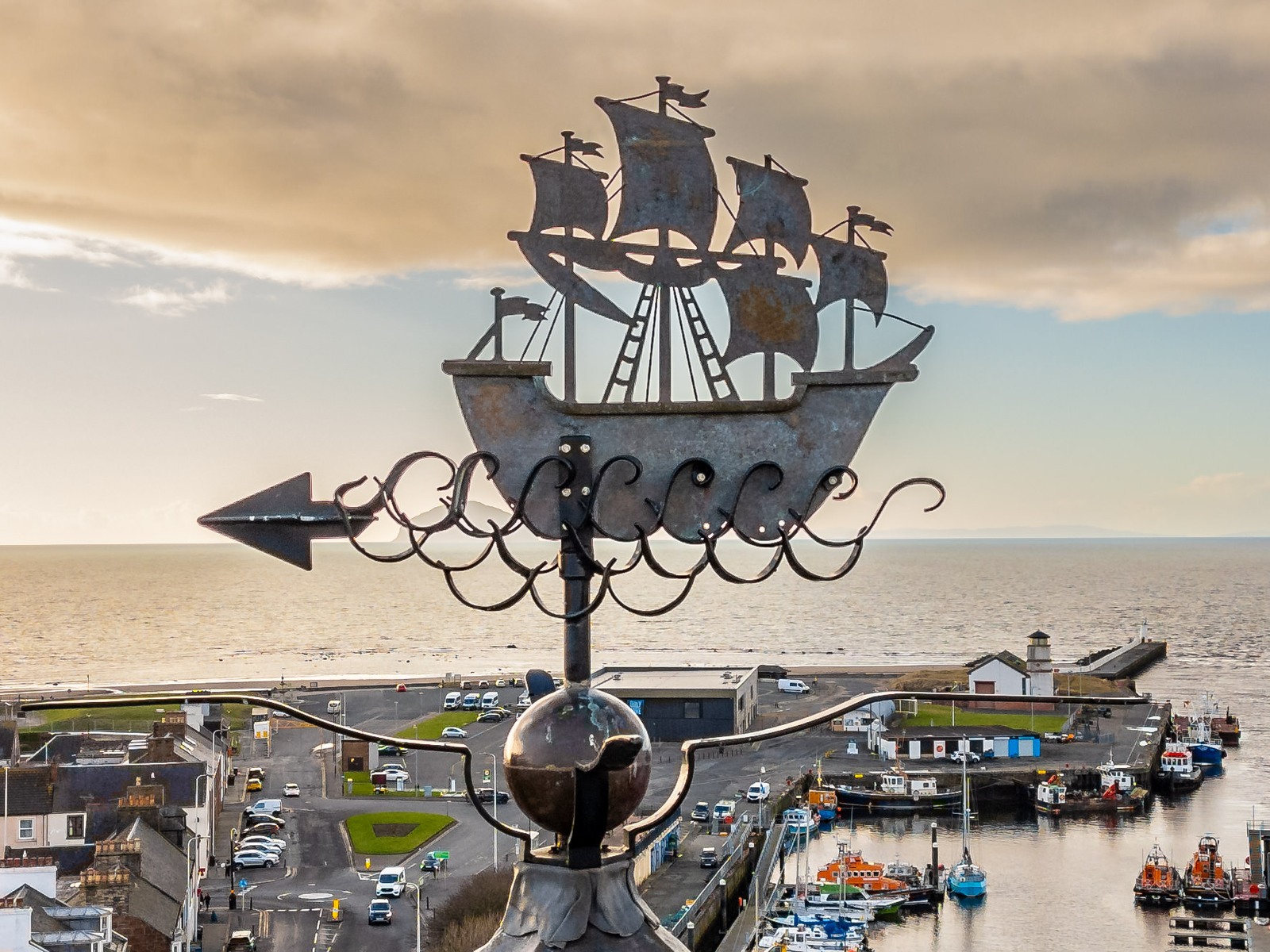
The clock faces stood above the prison floors, with an octagonal belfry above them. By 1892, the belfry carried a low, tapering, lead-covered spire and a weather-vane. The architect James Archibald Morris described that arrangement for Lawson’s book.[5]
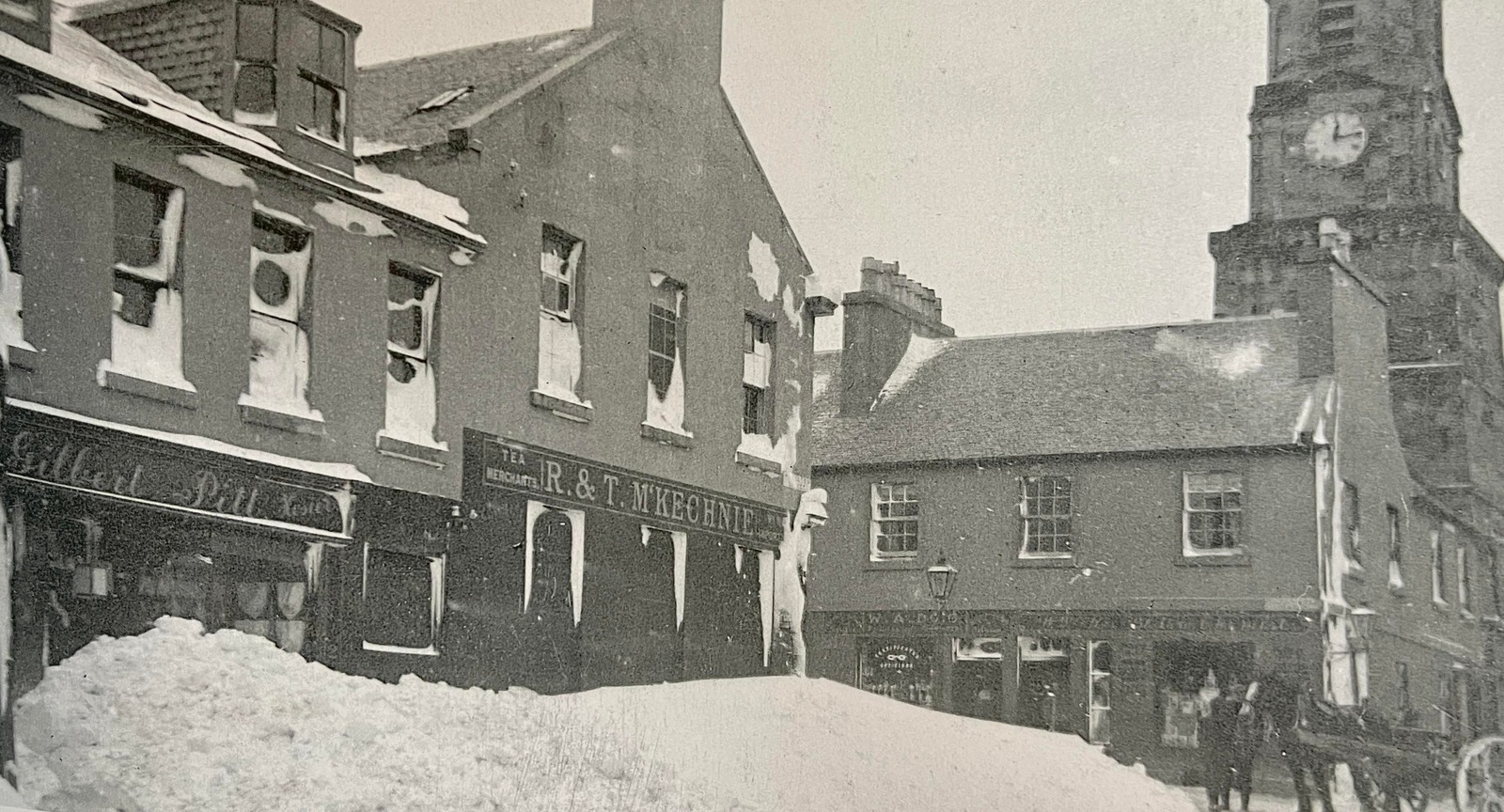
The surrounding Town’s Buildings accommodated trade as well as civic business. The 1851–52 directory lists Robert and Thomas M’Kechnie there as wholesale grocers, spirit dealers and shipping agents. John M’Dowall was another grocer and spirit dealer at the Town’s Buildings on Dalrymple Street, while John Ross, the town’s officer, also had an address in the complex.[9]
An escape in a tale
Stumpy also had a place in local storytelling. In Andrew Glass’s Kirkdandie Fair, published in 1873, Jamie Gordon of the Maid of Carrick is held in the old prison awaiting removal to Ayr. Nannie Brown visits him wearing two gowns. Gordon leaves disguised in her clothes, his face muffled in a plaid, while Nannie stays behind. The keeper discovers the exchange the following morning.[10]
A new hall, with Stumpy kept
When a new town hall was proposed in 1908, preserving the steeple was part of the offer. John McMaster, a banker living in Canterbury, offered £7,500 towards the scheme on condition that the hall be built on the old site and the steeple retained. McMaster was a native of Kirkoswald. The new building would carry his name.[3], [11]
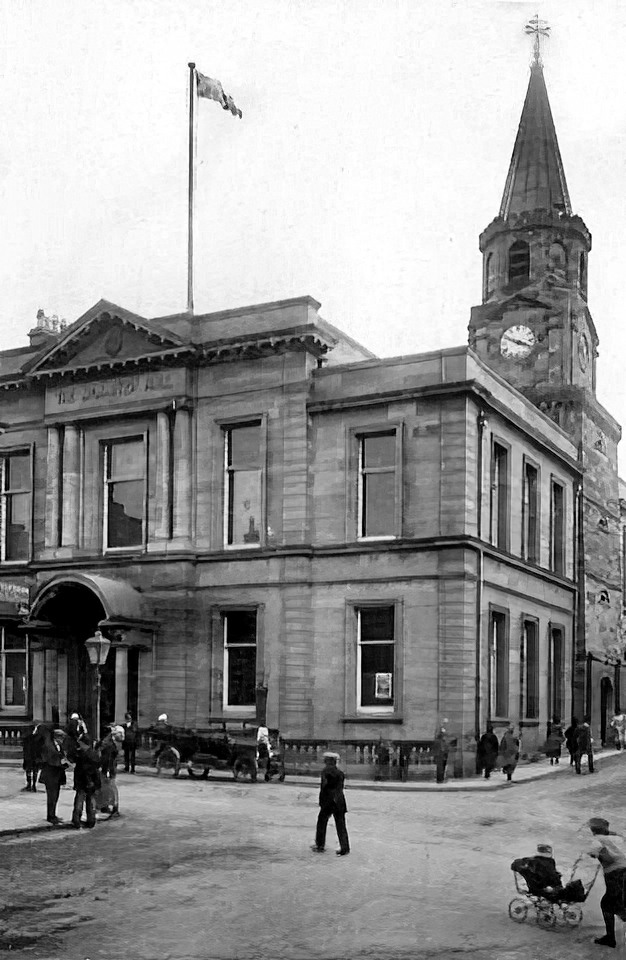
The old town hall was demolished in 1909, and Stumpy was incorporated into the side of its replacement. Provost Alexander Telfer laid the foundation stone on 29 October that year. The inscription names W. J. Jennings of Canterbury as architect and John Train & Taylor of Rutherglen as builders.[1], [11]
McMaster opened the hall on 17 August 1911. Girvan’s businesses observed a half-holiday, and a large crowd attended. At the Dalrymple Street entrance he received a gold key; Provost Hugh Hamilton Hutchison accepted the gift for the town. McMaster was also made an honorary burgess, receiving the freedom of the burgh.[11], [12]
Built in Giffnock stone, the new hall was estimated at the opening to have cost more than £15,000, excluding the site. Celebrations included dinner in the Lesser Hall, an evening assembly and a bonfire at the harbour. The building brought the Council Chambers, Police Court, Main Hall and committee rooms together beside the old tower.[12], [13]
The fire of March 1939
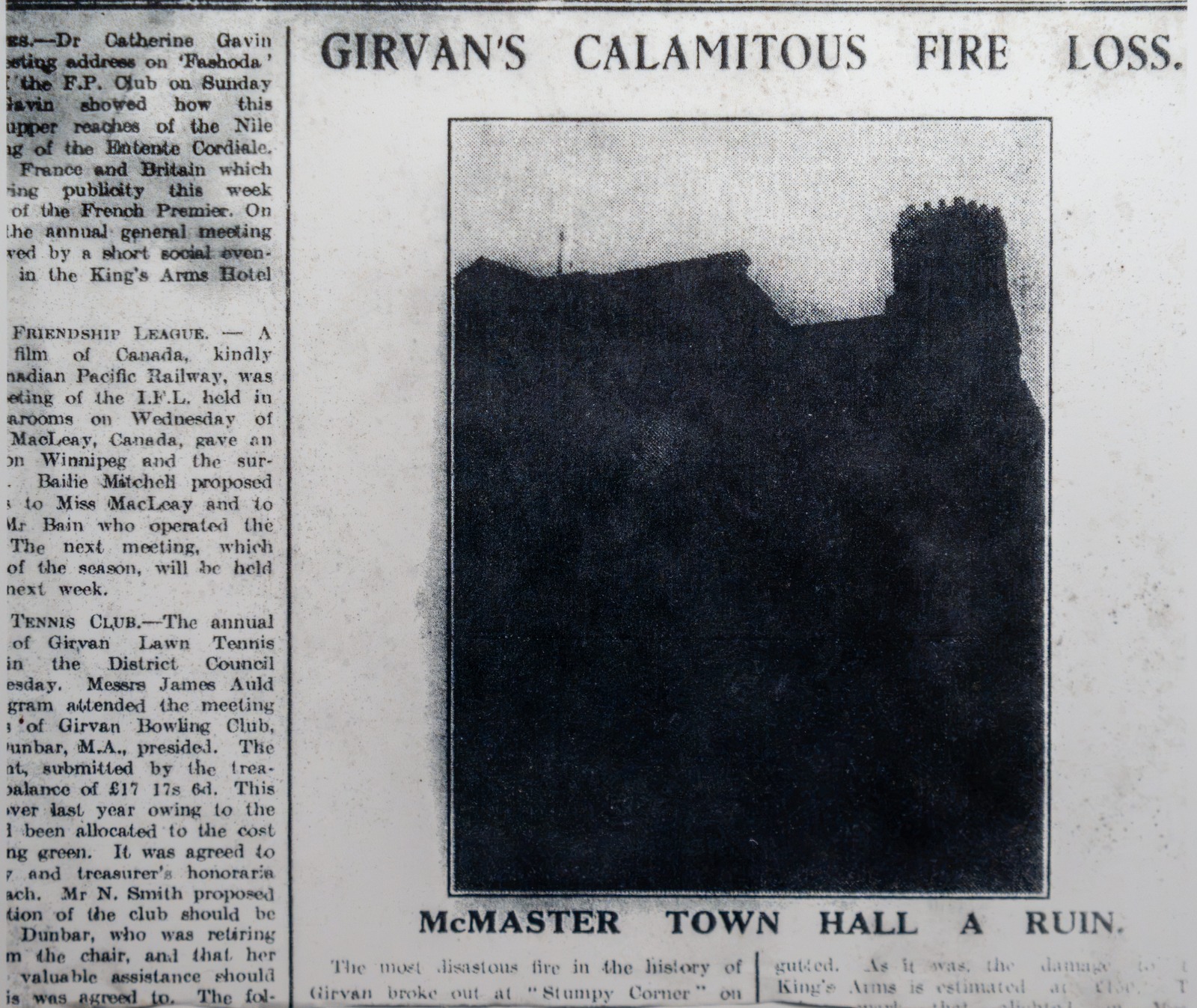
On the afternoon of 20 March 1939, women were preparing for a rally in McMaster Hall when fire broke out. Hall keeper James M’Creath warned them to leave, then rang the tower bell to summon Girvan’s brigade. Townspeople entered the hall to carry out pictures and furniture.[13]
Brigades from Ayr and Kilmarnock were summoned. The Ayr brigade broke down at Kirkoswald, and cars were sent to bring its men to Girvan. Fires on nearby roofs were extinguished, but the hall was destroyed after a three-hour firefighting effort. The following day’s Scotsman reported that 8,000 gas masks stored in the basement had been ruined by heat and water.[13]
The Scotsman reported that the clock kept going for more than an hour with flames around it.[13]
The fire badly damaged Stumpy and destroyed its spire.[1], [13]
Girvan then had to manage without its town clock. In April, Councillor R. Snow pressed for it to be put back into use, arguing that townspeople needed a reliable means of knowing the time. The council waited for expert advice.[14]
Later that month, D. R. Conway proposed an electric clock on the spire of Girvan Old Church. The council rejected the proposal and deferred repairs while awaiting a report on the condition of Stumpy and its clock. By August, architects’ reports on rebuilding McMaster Hall were before the council, but no decision had been announced.[15], [16]
Parts of McMaster Hall survived the fire. In July 1940, the council granted the Local Defence Volunteers permission to use the upper storey, which had a concrete floor, as a miniature rifle range.[39]
The hall’s ruins were still standing in July 1949, when the council agreed to demolish them.[40] Work finally began in late 1955. Before demolition started, protests were chalked on the walls. Removing the adjoining masonry raised fears for the tower’s stability, and the council allocated £3,000 for demolishing the hall walls and another £3,000 to preserve and make the steeple safe. Stumpy was still without its spire that December.[42]
The tower and the stones
By October 1957, an ornamental and hanging garden occupied the site of McMaster Hall, and Stumpy was described as almost restored.[43] The tower’s spire was eventually replaced. A post-war study of Ayrshire’s bells records the Stephen Miller bell, dated 1826, as the clock’s hour bell.[1], [17]
On 5 October 1959, high wind blew down the south face of the town clock. It embedded itself in the garden beneath the tower, narrowly missing sisters Isabel and Mary McGarva, who were taking two-year-old Alexander Murdoch for a walk.[46]
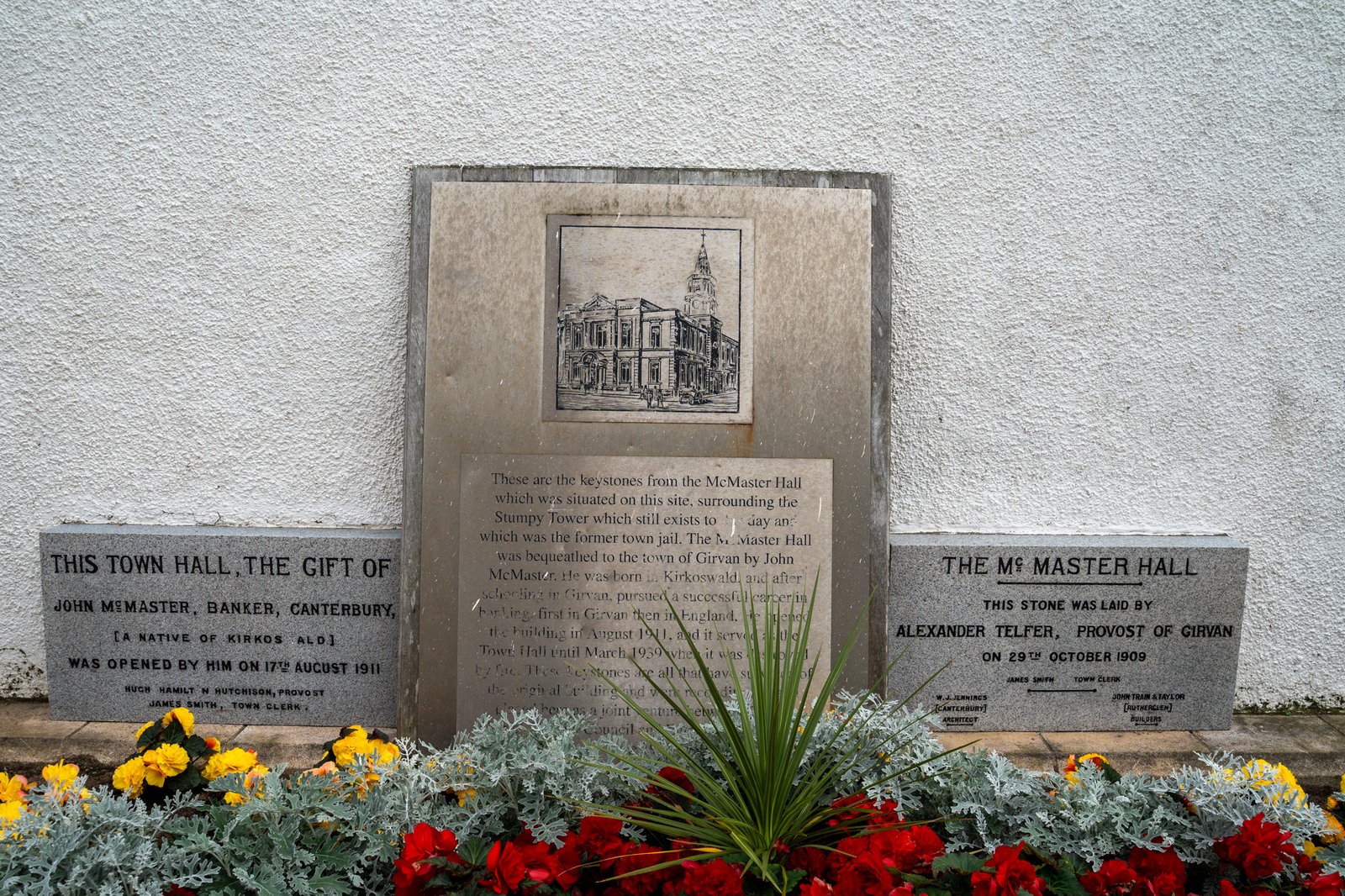
Two inscribed stones from McMaster Hall remain beside it. One records the laying of the foundation stone in 1909, with the names of the provost, architect and builders. The other records McMaster’s gift and his opening of the hall on 17 August 1911. A notice between them dates their reconditioning and placement here to June 1993.[11]
McMaster had also provided money for the hall’s upkeep and for its keeper. Those funds survived the loss of the building. In 2010, South Ayrshire Council proposed combining them into a McMaster Fund to help maintain Stumpy and the surrounding ground.[18]
Stumpy today
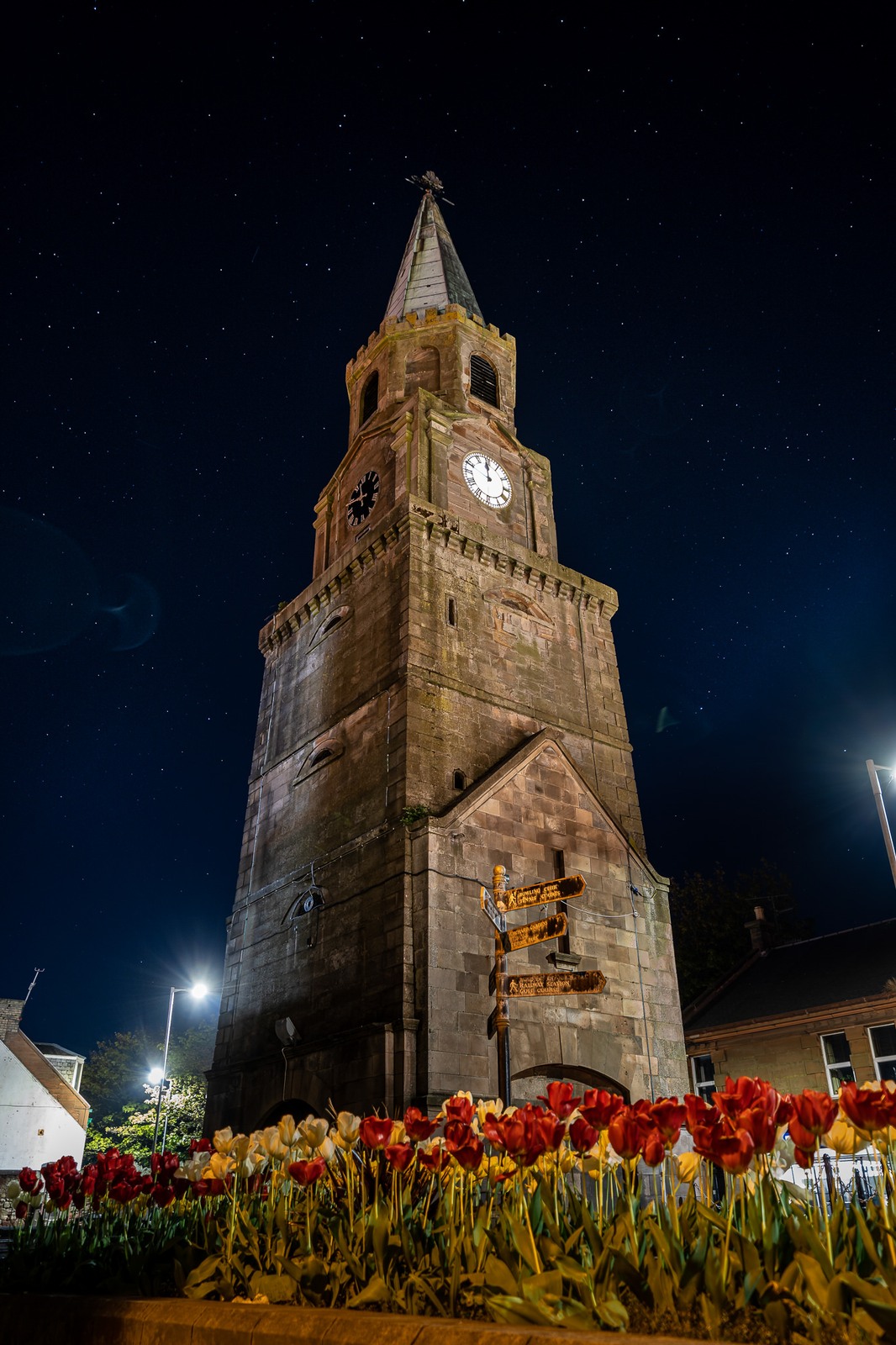
The plaza around Stumpy was renewed in 2024, with work completed that December. The Stumpy Corner Steering Group and South Ayrshire Council helped develop the improved space for community events.[19], [20]
Girvan & District Attractions opens the tower seasonally, supported by volunteers from Girvan Opportunities. Inside are four floors of exhibits, reached by the original steep stone stairs. The tower is closed for the 2026 season; opening times for 2027 are to be confirmed by Girvan & District Attractions.[21]
On the ground floor, visitors can try turning a crank. Displays on the upper levels describe wider Victorian prison life, alongside material about Girvan and Stumpy. The crank gives visitors a practical introduction to penal labour elsewhere; Stumpy’s own inspection of 1845 says that no work was provided for its prisoners.[41], [8]
Further restoration is now funded through Girvan’s Story. Historic Environment Scotland, the National Lottery Heritage Fund and South Ayrshire Council are supporting work to restore and preserve Stumpy, with the project scheduled for 2029–2030.[22]
Sources
1. RCAHMS, Tolbooths and Town-Houses: Civic Architecture in Scotland to 1833 (1996), pp. 96–97; account reproduced by Historic Environment Scotland.
2. Third Report of Inspectors of Prisons, Girvan, p. 44; inspection September 1837, in Accounts and Papers, 1838.
3. Irvine Herald, 3 July 1908, p. 3, “Girvan’s Steeple”.
4. William Howie Wylie, Ayrshire Streams (1851), pp. 126–127.
5. Roderick Lawson, Places of Interest about Girvan (1892), pp. 19–20.
6. Local Reports of the Commissioners on the Municipal Corporations in Scotland, Girvan, pp. 77–78, catalogue date 1835.
7. General Board of Directors of Prisons in Scotland: Third Report (1842), pp. 10–11; Fourth Report (1843), pp. 15, 17; Fifth Report (1844), p. 16.
8. Inspectors of Prisons, Scotland: Girvan, inspection 25 April 1845, p. 31, Parliamentary Papers, 1845.
9. The Ayrshire Directory, 1851–52, pp. 202–204.
10. Andrew Glass, Tales and Traditions of Ayrshire and Galloway (1873), “Kirkdandie Fair”, pp. 75–84.
11. McMaster Hall foundation and opening stones, commemorative notice and Girvan Town Trail panel at Stumpy.
12. The Scotsman, 18 August 1911, p. 7, “Opening of Girvan Town Hall”.
13. The Scotsman, 21 March 1939, p. 13, “8000 Gas Masks Ruined”.
14. Daily Record, 12 April 1939, p. 3, “They Want the Time”.
15. The Scotsman, 26 April 1939, p. 11, “Girvan Town Bell and Clock”.
16. The Scotsman, 12 August 1939, p. 11, “Girvan and Town Hall Question”.
17. R. W. M. Clouston, The Church Bells of Ayrshire, pp. 202, 226.
18. South Ayrshire Council, Amenity Trusts, Funds and Bequests, 16 December 2010, p. 3.
19. GoGirvan, Stumpy Tower, plaza renewal and visitor information; accessed 11 October 2026.
20. South Ayrshire Council, General Services Capital Programme 2025/26, Cabinet, 17 February 2026, p. 59, Stumpy Tower Corner.
21. Girvan & District Attractions, Stumpy Jail, visitor information; accessed 11 October 2026.
22. Girvan’s Story, Progress: Stumpy Jail restoration, funding and project timescale; accessed 11 October 2026.
23. Girvan council minute, 8 July 1825; extract reproduced in Stumpy Jail’s interior exhibition.
24. William Eaton, Sheriff Substitute of Ayrshire, jail certificate, 7 April 1827; reproduced in Stumpy Jail’s interior exhibition.
25. National Records of Scotland, Ayrshire Ordnance Survey Name Books, 1855–1857, OS1/3/29, p. 25, Town Hall; online transcription.
26. General Board of Directors of Prisons in Scotland, Twelfth Report (1851), p. 16.
27. National Records of Scotland, “A brief history of Largs Jail”, account of the Committee on Local Prisons’ recommendation, 5 May 1853.
28. Slater’s Directory, 1860, Girvan, pp. 360–362.
29. Thomas Hamilton, The Ayrshire Commissioners of Supply, p. 166, account of the minute of 30 April 1860.
30. Ordnance Survey, Ayrshire LV.4, Girvan, 1909, revised 1907–1908; National Library of Scotland.
31. Records of the Parliaments of Scotland, 1669/10/117, ratification, 23 December 1669; English translation.
32. “A Description of Carrict”, attributed to William Abercrummie, in Geographical Collections relating to Scotland, vol. II (1907), pp. 14, 16; account dated between 1683 and 1722 in the editor’s preface, pp. xxvi–xxvii.
33. Caledonian Mercury, 10 May 1817, p. 4, Circuit Intelligence, Ayr, 24 April.
34. Edinburgh Evening Courant, 6 October 1828, p. 4, Circuit Intelligence, Ayr.
35. Libraries Tasmania, convict conduct register CON31/1/38, image 353, James Shaw, entry 1040, York, 1829.
36. Caledonian Mercury, 27 April 1833, p. 4, Circuit Court of Justiciary, Ayr.
37. Scottish Indexes, James Sinclair’s trial, 1842, index to JC26/1842/262; Ayr prison entry, HH21/27/2, p. 121.
38. Ardrossan and Saltcoats Herald, 4 October 1862, pp. 2–3, William McCreadie’s trial.
39. Daily Record, 10 July 1940, p. 8, McMaster Hall and the Local Defence Volunteers.
40. Greenock Telegraph, 15 July 1949, p. 12, decision to demolish McMaster Hall’s ruins.
41. Stumpy Jail, ground-floor visitor crank demonstration and interior displays, “What is a crank machine?” and “Life in a Victorian prison”.
42. The Scotsman, 30 December 1955, p. 4, “Preserving Stumpy: Girvan Town Hall Comes Down, But Tolbooth Stays”.
43. Sunday Mail (Glasgow), 27 October 1957, p. 5, Jack Robertson’s Page, “Garden”.
44. The Glasgow Herald, 23 April 1925, p. 7, town-steeple centenary paragraph following “Johnston Hammerman’s Death”.
45. Edinburgh Evening Courant, 9 July 1862, p. 4, “Station-houses”, Ayrshire paragraph.
46. The Scotsman, 6 October 1959, p. 4, “Time Flies in Girvan”.
Image credits and enquiries
Contemporary photographs: Owner photograph. Historic views of the archway, snowy street and McMaster Hall: Owner collection; photographer unidentified. Fire report: Carrick Herald, 24 March 1939; Owner photograph of the exhibition display.
Images are included to illustrate Girvan and Carrick’s history for educational purposes. Sources and photographers are credited where known. If you hold rights in an image, please contact us so we can review its use, correct the credit or remove it.
Pass the story on