The making of the coast
The woman who read Girvan’s vanished sea
Key dates
- 1831
Elizabeth Anderson is born at Alloway.
- 1836
Her family moves to Enoch farm near Girvan.
- 1866
The family presents a substantial fossil collection to the Hunterian.
- 1878–1880
A major Girvan fossil study draws on the Gray Collection.
Show all 9 dates Show fewer dates
- 1903
Elizabeth receives the Murchison Fund.
- 1920
The British Museum agrees to buy her principal collection.
- 1923
Elizabeth is still collecting at Balclatchie, aged 92.
- 1924
Elizabeth dies; her daughters continue collecting.
- 1937
The daughters give a further collection to the museum.
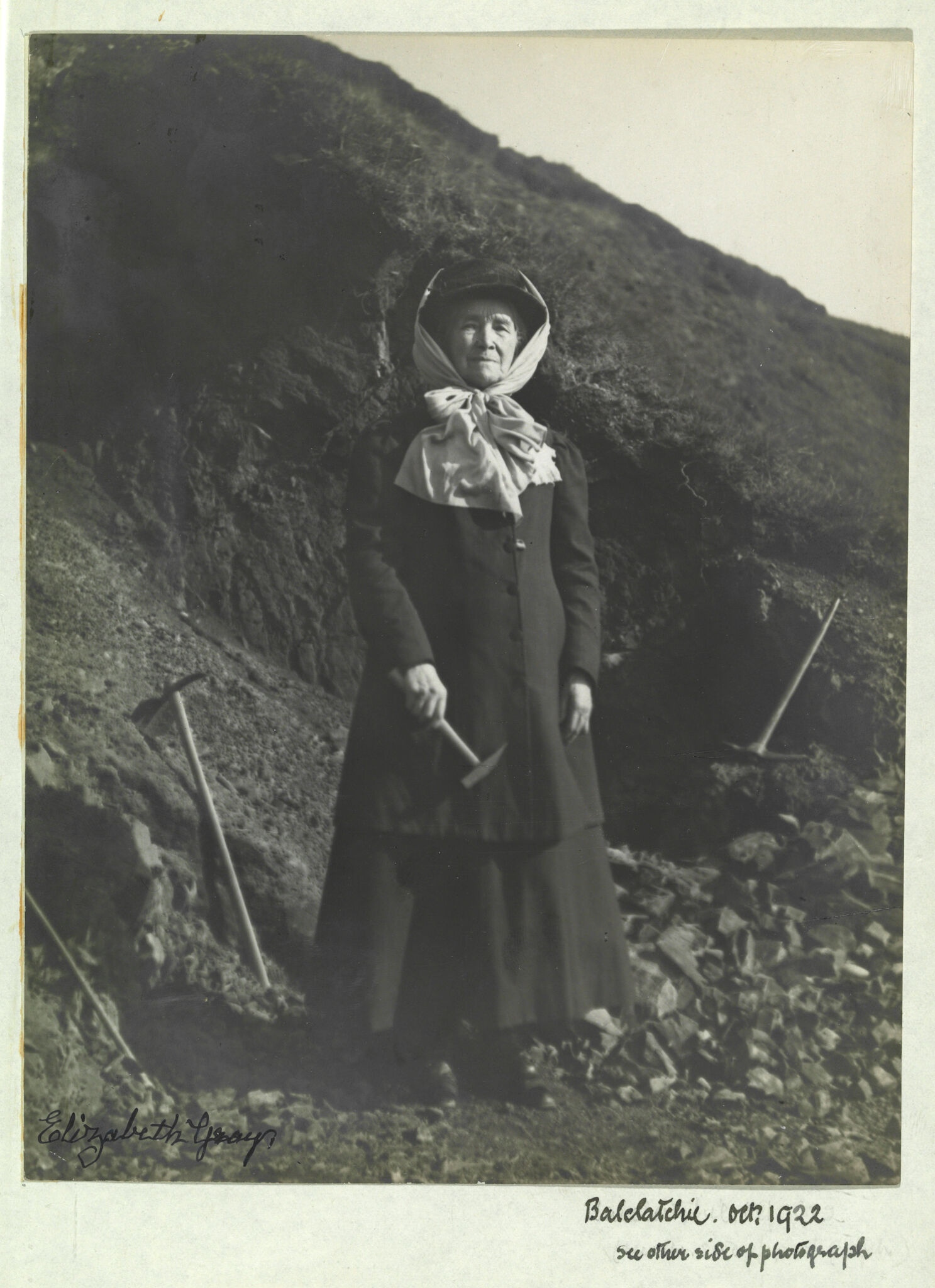
In September 1923, Elizabeth Gray was still collecting fossils at Balclatchie, near Girvan. She was 92. For more than sixty years she had searched the district’s shore, burns and quarries, building a collection that supplied material for major studies of ancient marine life. Her daughters worked with her and continued collecting after her death.[1]
Enoch farm and a shared pursuit
Elizabeth Anderson was born at the Burns Arms Inn at Alloway in 1831. In 1836 her family moved to Enoch farm, near Girvan. Her father, Thomas Anderson, collected local fossils, and his interest helped introduce her to the rocks around their home. Scientists later named the trilobite Bronteus andersoni and the coral Pinnacopora andersoni in his honour.[1]
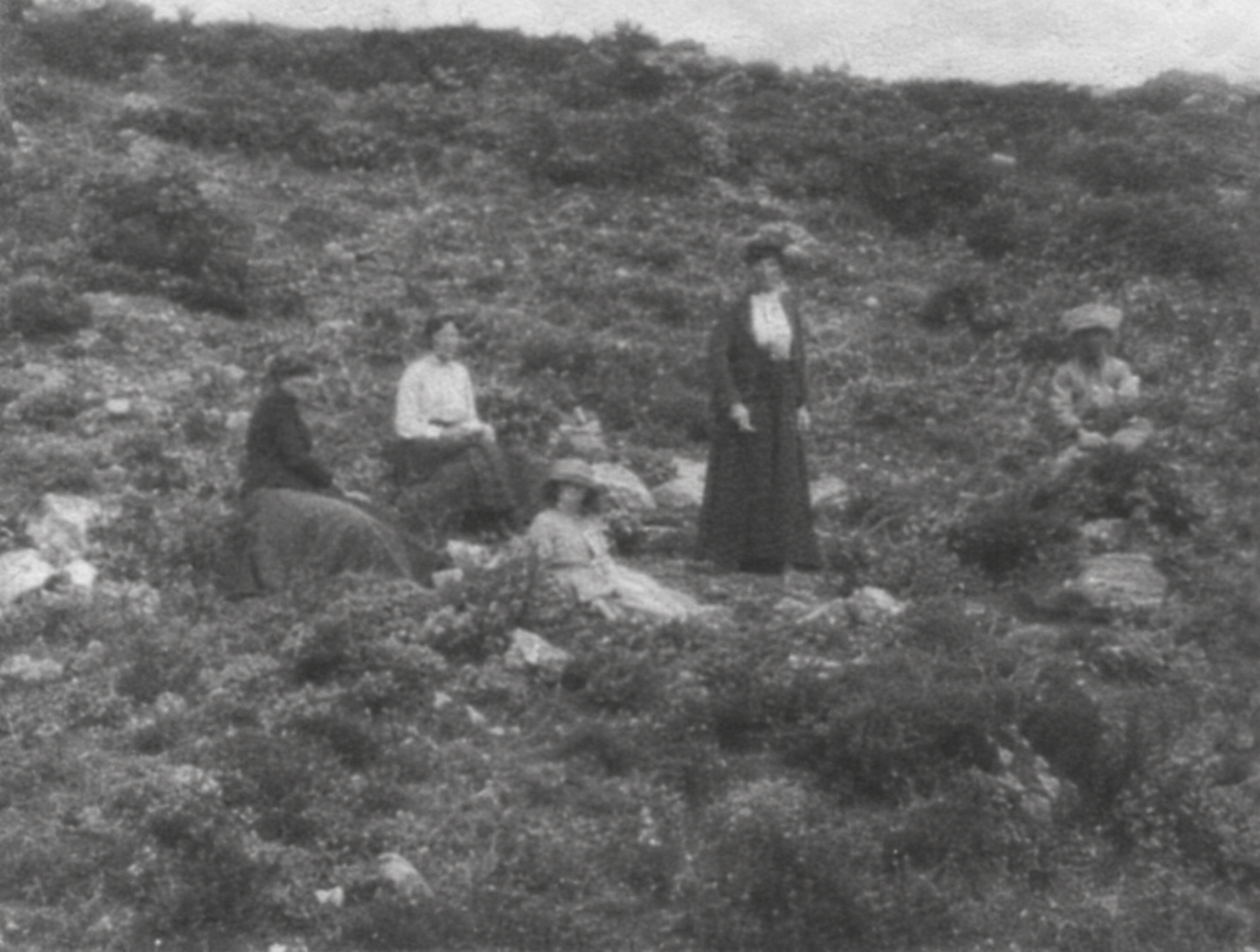
In 1856 Elizabeth married Robert Gray, a Glasgow bank official and naturalist. The family returned to Girvan for summer holidays, and fossil collecting became a shared pursuit. Alice later recalled that her sister Agnes was already a trusted helper at five or six years old. Alice, Agnes and Mary appear with their mother in a photograph taken at the Starfish Bed at Lady Burn in October 1922.[1]
The family’s recollections place the beginning of their collecting in 1855; other accounts give 1860. Elizabeth herself, writing in 1882, gave 1863. By 1866 they had assembled a substantial collection, which they presented to the Hunterian Museum at Glasgow University.[1]
Elizabeth also attended geology classes for women organised by Professor John Young at Glasgow University. She held no university post, but developed her knowledge through collecting, correspondence and years of examining the same district. Robert’s work took the family to Edinburgh in 1874; their visits to Girvan continued.[1]
The fossils and the ground they came from
The rocks around Girvan preserve marine life from the Ordovician and Silurian periods. Much of Elizabeth’s collection came from Ordovician rocks, formed hundreds of millions of years ago. The district then lay on the subtropical fringe of Laurentia, the ancient continent that included much of present-day North America.[1][2]
These were changing seas. Some beds formed in shallow water, others far below the surface. Submarine currents and collapsing slopes carried sediment and animal remains into deeper water. Volcanic rocks also contributed debris. Later movement folded and faulted the layers; uplift and erosion exposed them around Girvan. Craighead, Ardwell and the foreshore offered different parts of this history.[2][3]
A fossil’s position mattered as much as its appearance. Knowing which bed it came from, and what other fossils occurred beside it, allowed specialists to compare the age and environment of different rocks. At the Whitehouse shore, fossils from the Mill Formation became part of the Gray Collection now held by the Natural History Museum.[2]
Collecting meant breaking hard rock, finding specimens, wrapping them and carrying them away. The family gathered shells, corals, trilobites and other remains, then prepared and sorted the material. Parcels were organised by locality, with information about the beds where specimens had been found. Elizabeth’s familiarity with the ground made her a valuable correspondent when specialists needed further examples or information about a site.[1]
Each fossil was wrapped as soon as it was found. In the evenings, the family packed the day’s finds into small parcels and labelled them by locality. They took care to keep both halves of a split fossil, since the matching impression could reveal details missing from the other half.[1]
Alice recalled a particularly difficult collecting trip in 1900, to a quarry she called “Bougang”. Forewarned that it was almost full of water, the family brought a thin rope. Her uncle held the rope attached to her while she lay flat at the edge, reaching down to quarry stone and pass it up to Elizabeth to break apart.[1]
The Gray Collection in print
When Charles Lapworth began working in the Girvan district in 1873, Elizabeth helped him explore the area and supplied fossils for his comparisons between rock beds. At his request, she searched particular layers for fossils he expected to find there. Her collecting helped him work out the district’s geological succession.[1]
H. Alleyne Nicholson and Robert Etheridge’s Monograph of the Silurian Fossils of the Girvan District in Ayrshire, issued in parts between 1878 and 1880, announced its debt in its title: it gave special attention to fossils in the “Gray Collection”.[1][4]
Elizabeth kept supplying new material as the work progressed. In the preface to the second part, dated November 1879, the authors explained that her collecting that summer had extended to localities not previously examined and produced a large quantity of additional fossils. They planned an extended supplement in the next part to describe new forms and add to their accounts of specimens already known.[4]
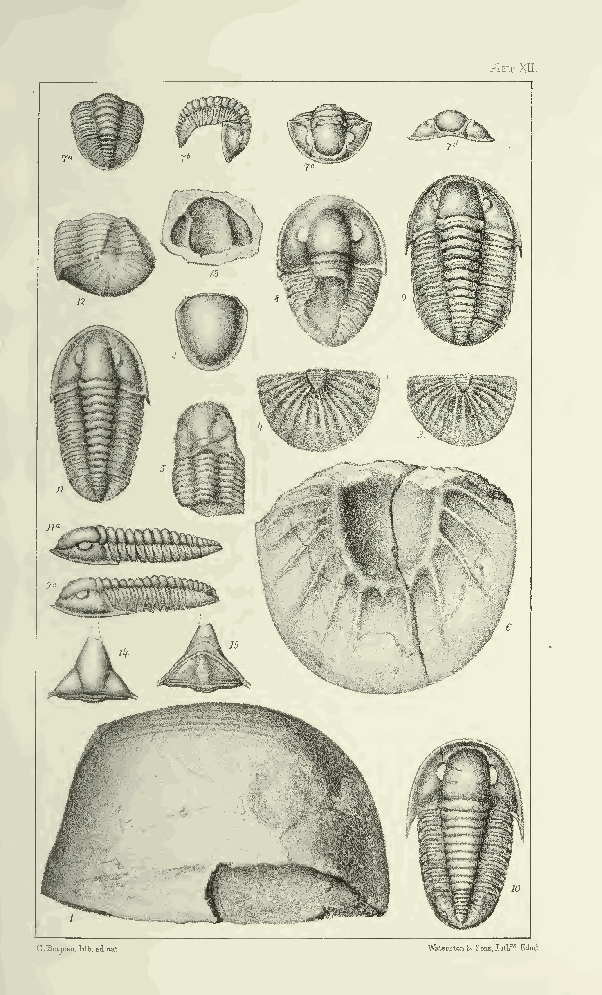
Among the trilobites described in 1879 was Proetus girvanensis, from Drummuck. Later placed in the genus Paraproetus, it still carries Girvan in its scientific name. The original description drew on specimens in Elizabeth’s collection and in the geological survey collections; the accompanying plate illustrated the animal’s body, head and side views.[4][5]
By 1882, Lapworth described the family’s collection as containing between 20,000 and 30,000 specimens. Its strength lay especially in shelly fossils gathered through repeated visits to productive sites.[1]
Agnes made a discovery of her own. In a letter written in 1937, Alice credited her sister with finding the first specimen of Cothurnocystis. The family called the unusual fossil “the boot”. When F. A. Bather named Cothurnocystis elizae, he honoured Elizabeth.[1]
Much of this specialist work was published by men, but women also studied Elizabeth’s finds. Jane Donald, later Mrs Longstaff, worked on her fossil gastropods—the group that includes snails. Elizabeth’s role involved finding suitable specialists, sending specimens and pursuing the work through correspondence, as well as collecting in the field.[1]
Around 1880, Robert Traquair of the Royal Scottish Museum offered to teach her to describe her own fossils. Alice recalled that her mother preferred to supply material to specialists who had devoted their lives to particular groups. Discovering and collecting fossils remained her principal interest.[1]
In 1903 the Geological Society of London awarded her the Murchison Fund in recognition of her geological work.[1]
Elizabeth was also elected an honorary member of the Geological Society of Glasgow and became a Fellow of the Royal Physical Society of Edinburgh.[1]
Payment for a family’s work
Parts of the collection had already reached museums in Glasgow and Edinburgh when Elizabeth offered her principal collection to the British Museum (Natural History) in London in May 1914. The purchase was agreed in March 1920 for £2,250. Packing, dispatching and accounting for the material took considerable work, including gathering specimens that were on loan to other researchers.[1]
Elizabeth wanted her daughters’ contribution recognised in the payment. On 27 May 1920 she asked that the money be made payable jointly to herself and her daughters, who had been her co-workers and collectors. The museum could pay only Elizabeth because its authority for the purchase had been issued in her name. She used the proceeds to establish a fund for her unmarried daughters.[1]
She acknowledged the final payment in March 1922. By then, most of the collection was installed at South Kensington. In September 1923 she was still out collecting at Balclatchie. Elizabeth died on 11 February 1924.[1]
The daughters carried on
The family’s collecting did not end with Elizabeth. In January 1937 Alice offered the British Museum the fossils they had gathered since the earlier purchase. Moving them from the family’s Edinburgh home at 59 George Street was a substantial undertaking. After the first consignment, Alice asked for help with the packing; the museum sent two members of staff to assist and carry the material down the stairs. It had all reached London by the beginning of May.[1]
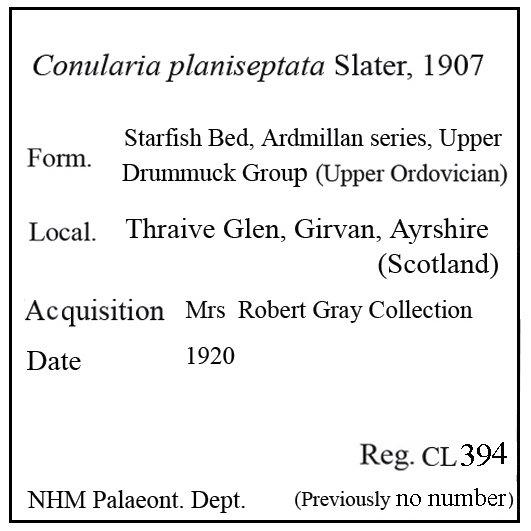
The daughters wanted the new material associated with their mother’s collection. The museum recorded the gift as the “Mrs Robert Gray Collection, 1937”. Although specimens were distributed among the museum’s specialist collections, their labels preserved the connection with the family. Smaller donations also reached the Sedgwick Museum at Cambridge.[1]
In 1937 Alice also marked the family’s collecting sites on six-inch Ordnance Survey maps and sent them to the museum. Working from memory, she recorded places that had become overgrown or difficult to recognise. Some of the positions she marked were later disputed, but the maps preserved her account of where the family had worked.[1]
After Alice’s death in 1942, Edith notified the museum of another group of fossils. Wartime transport difficulties delayed arrangements, and Edith died in Edinburgh in October 1944. Geological Survey staff helped pack and store the remaining material in 1945.[1]
The Gray collections gave researchers both specimens to describe and information about where they had been found. Their value came from repeated visits, careful preparation and the work of several generations of one family.[1]
Looking at Girvan’s rocks today
Fossil-bearing beds are still exposed along the coast south of Girvan. At Ardwell, layers of ancient seabed can be seen bent into tight folds. Other exposures continue along the Whitehouse shore.[2]
If you want to collect fossils, follow the Scottish Fossil Code: seek permission, check restrictions at the site and keep collecting to a minimum. Do not hammer protected bedrock. Record exactly where each find came from and keep that information with the specimen. Photograph unusual finds in place and seek advice before removing them.[6]
References
1. R. J. Cleevely, R. P. Tripp and Y. Howells, Mrs Elizabeth Gray (1831–1924): a Passion for Fossils, Bulletin of the British Museum (Natural History), Historical Series 17(2), 1989, pp. 167–258. Particularly pp. 168, 171–180 (family, methods and fieldwork), 185, 189–190 (specialists), and 204–210 (museum transactions and later collections). Held scan; quoted correspondence is reproduced in this study. Additional passages: p. 173 (Agnes’s find), p. 175 (preparation and honours), p. 177 (quarry episode and family names for fossils), p. 179 (Alice’s maps), p. 183 (Lapworth collaboration), p. 213 (collection size and emphasis), p. 218 and p. 234, note 108 (Cothurnocystis naming and finder). Publication record.
2. J. Keith Ingham, “Girvan foreshore”, in J. D. Lawson and D. S. Weedon (eds), Geological excursions around Glasgow & Girvan, 1992: introductory details and localities 2, 6, 7, 10 and 12. BGS-hosted chapter. Retained capture.
3. British Geological Survey, Ayr district, sheet 14W and part of 13, 1:50,000 sheet description, Scotland, Craighead Inlier and Drummuck succession. BGS memoir. Retained capture.
4. H. A. Nicholson and R. Etheridge Jr, A monograph of the Silurian fossils of the Girvan district in Ayrshire, fasciculus II, 1879: title page, preface v–vi, pp. 169–174 and plate XII, figures 7–10 with key. Original scan. Retained complete scan.
5. P. A. Jell and J. M. Adrain, “Available generic names for trilobites”, Memoirs of the Queensland Museum 48(2), 2002, p. 421. Current accepted combination also checked against GBIF taxon 8680838, 12 October 2026.
6. NatureScot, Scottish Fossil Code and Guidance, including the 2023 Code. Guidance. Checked 12 October 2026.
Image credits and enquiries
Portrait: historical photograph; photographer unidentified. Inscribed Balclatchie, October 1922.
Museum label for Conularia planiseptata, recording the Mrs Robert Gray Collection and its acquisition in 1920. Natural History Museum, London, PI CL 394. Photograph: Consuelo Sendino / The Trustees of the Natural History Museum, London. Source · CC BY 4.0. Unmodified.
Trilobite plate: Charles Berjeau, plate XII in Nicholson and Etheridge’s Girvan monograph, fasciculus II (1879), University of Illinois copy via Internet Archive.
Images are included to illustrate Girvan and Carrick’s history for educational purposes. Sources and photographers are credited where known. If you hold rights in an image, please contact us so we can review its use, correct the credit or remove it.
Pass the story on