Girvan in remembrance
The garden behind the walls
Key dates
- 1857
The town survey records the orchard.
- 25 June 1950
The Garden of Remembrance opens beside Orchard Gardens.
- 1951
The Girvan women’s section wins the Haig Cup for a fifth successive year.
- 1960
A holiday feature celebrates Orchard Gardens.
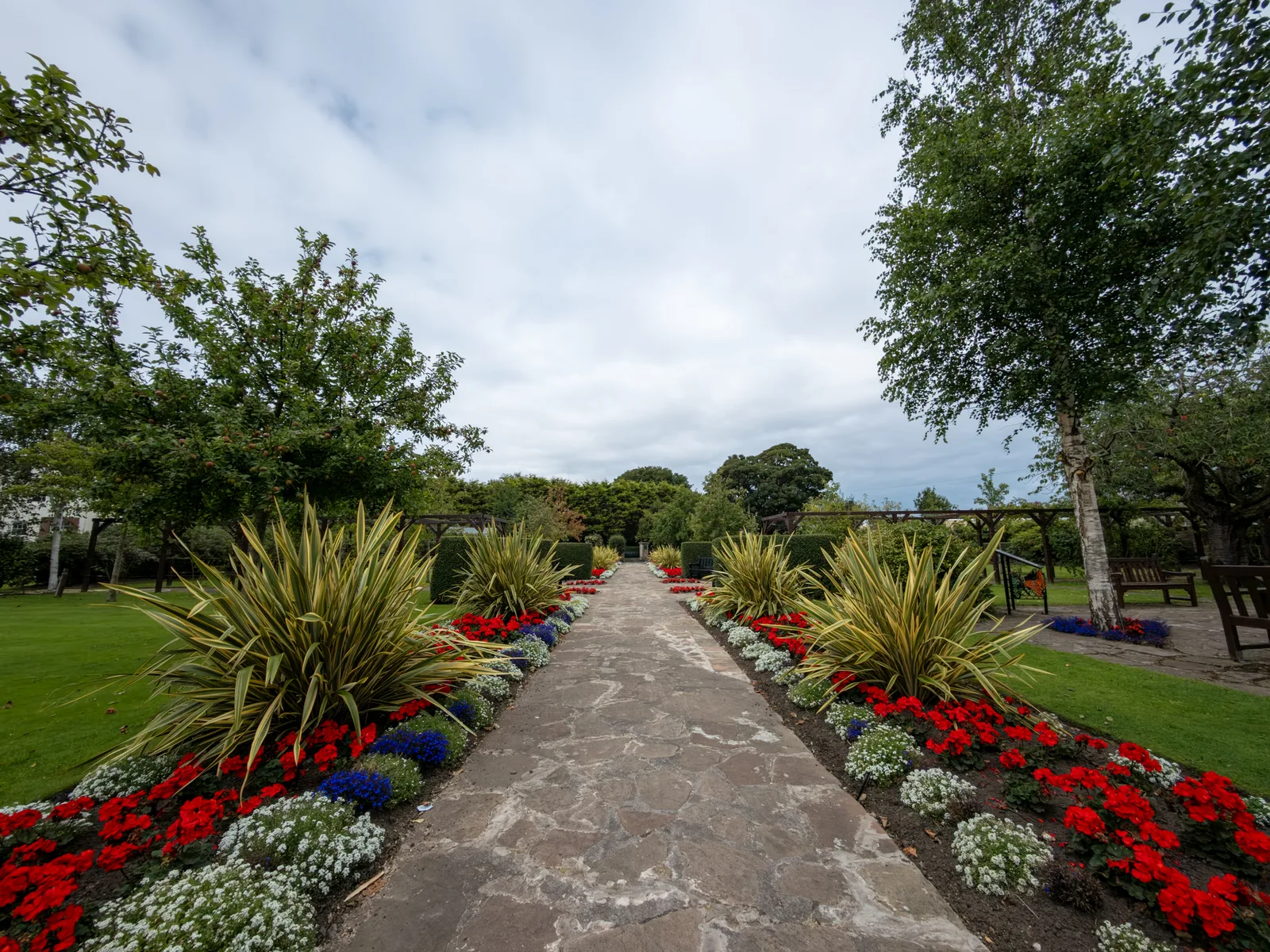
Behind the walls on The Avenue, Orchard Gardens offers a quieter corner of Girvan: flower borders, lawns, mature trees, a lily pond and places to sit. Follow the path to the back and low steps lead into the neighbouring Garden of Remembrance. Its plaque names the women who presented it in 1950. A short newspaper notice now gives us the day it opened: 25 June.[1][2]
The two gardens bring together an older landscape of enclosed, planted ground and a place dedicated to the losses of the Second World War.
When The Avenue was Bank Street
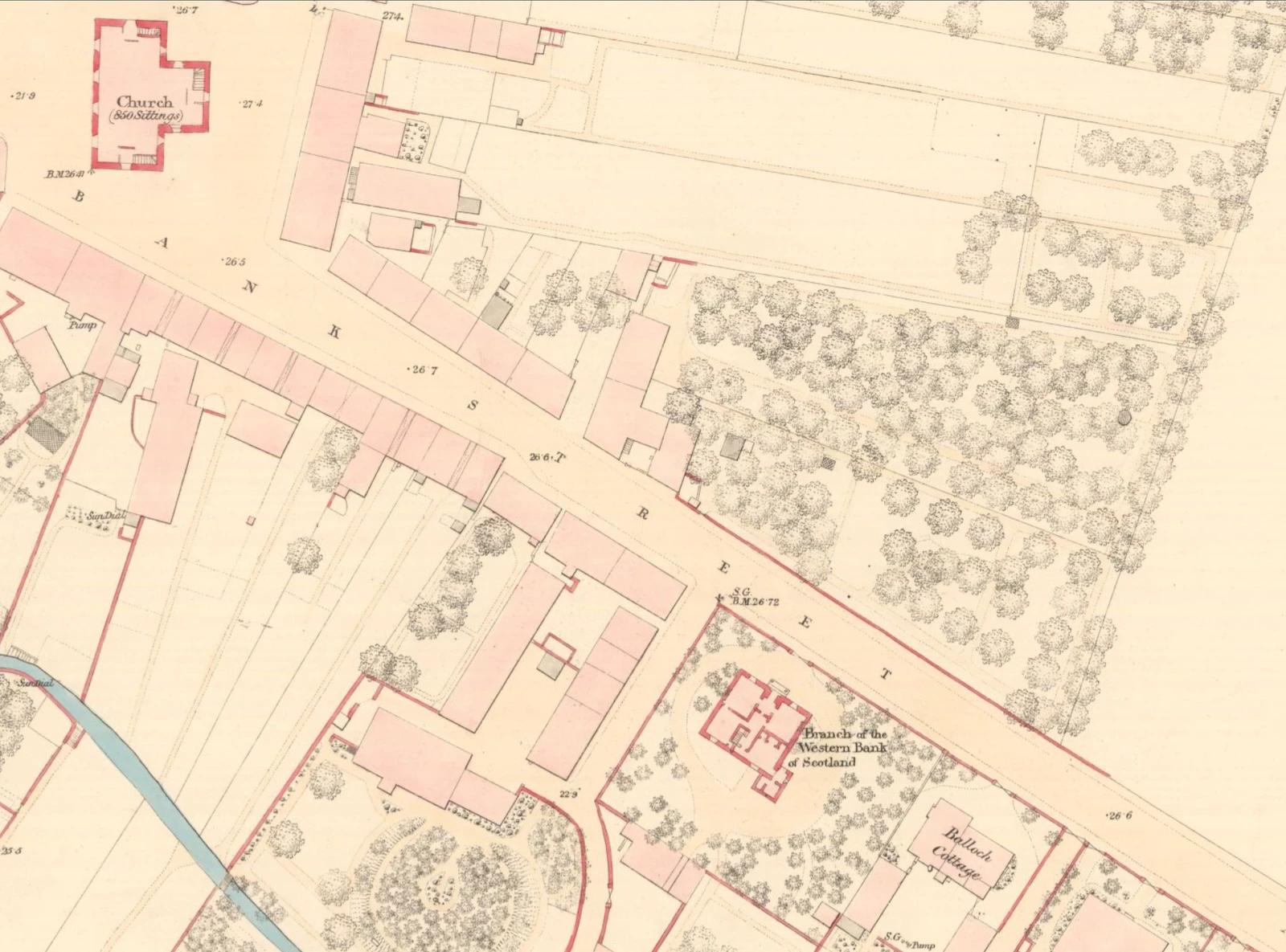
The old town plan makes the planting strikingly clear. Along the road labelled Bank Street, trees stand in close, ordered rows within a large enclosure. Buildings face the street, with gardens and other cultivated plots stretching behind them. A small structure sits among the trees near the roadside edge. Further back, boundaries divide the ground into separate enclosures, some more lightly planted than others.[3]
This was a varied landscape of houses, gardens and orchard planting. Across Bank Street, the plan names the Western Bank of Scotland and Balloch Cottage. An oval garden lies behind the buildings on that side of the road, close to the Mill Burn. The burn runs south of the street, separated from the densely planted northern enclosure by the road and intervening properties.
The detail comes from the Ordnance Survey town plan surveyed in 1857 and published in 1859. The wider sheet surveyed in 1856 also labels the road Bank Street; on the map revised in 1894 and published in 1897, the corresponding road is called Avenue.[4][5]
The rows of trees give the modern garden's name a visible historical setting. The maps preserve the arrangement of planted ground along the street long before the newspaper descriptions of Orchard Gardens as a visitor attraction.
A garden in the holiday town
By April 1960, Orchard Gardens was part of Girvan's holiday appeal. William Taylor's Daily Record feature took readers through a resort of fishing, golf, tennis, harbour amusements and open-air dancing in Stair Park. Visitors could fill their days with activity, but Taylor also made room for those seeking a quieter holiday. He turned to the town's gardens and bowling greens, describing Orchard Gardens as “a landscape gardener’s paradise”.[6]
That description suits the sheltered paths and formal borders in the garden today. Seats stand beneath the trees, with lawns beside the planting. Fruit hangs from a tree beside the main path.
Sunday, 25 June 1950
Ten years before Taylor's visit, the remembrance garden had opened at the back of Orchard Gardens. The Paisley Daily Express reported the ceremony on Monday, 26 June 1950. The garden had been opened and dedicated the previous day, and Mrs G. M. K. Young unveiled a plaque commemorating those who lost their lives in the Second World War.[1]
She was Nina Arthur Young, née Carmichael, wife of George Murdoch Kirkpatrick Young of Glendoune. Their marriage took place at the West Church in Greenock on 12 March 1935. A later family notice names Nina explicitly as the wife of Major G. M. K. Young of Glendoune, Girvan.[8]
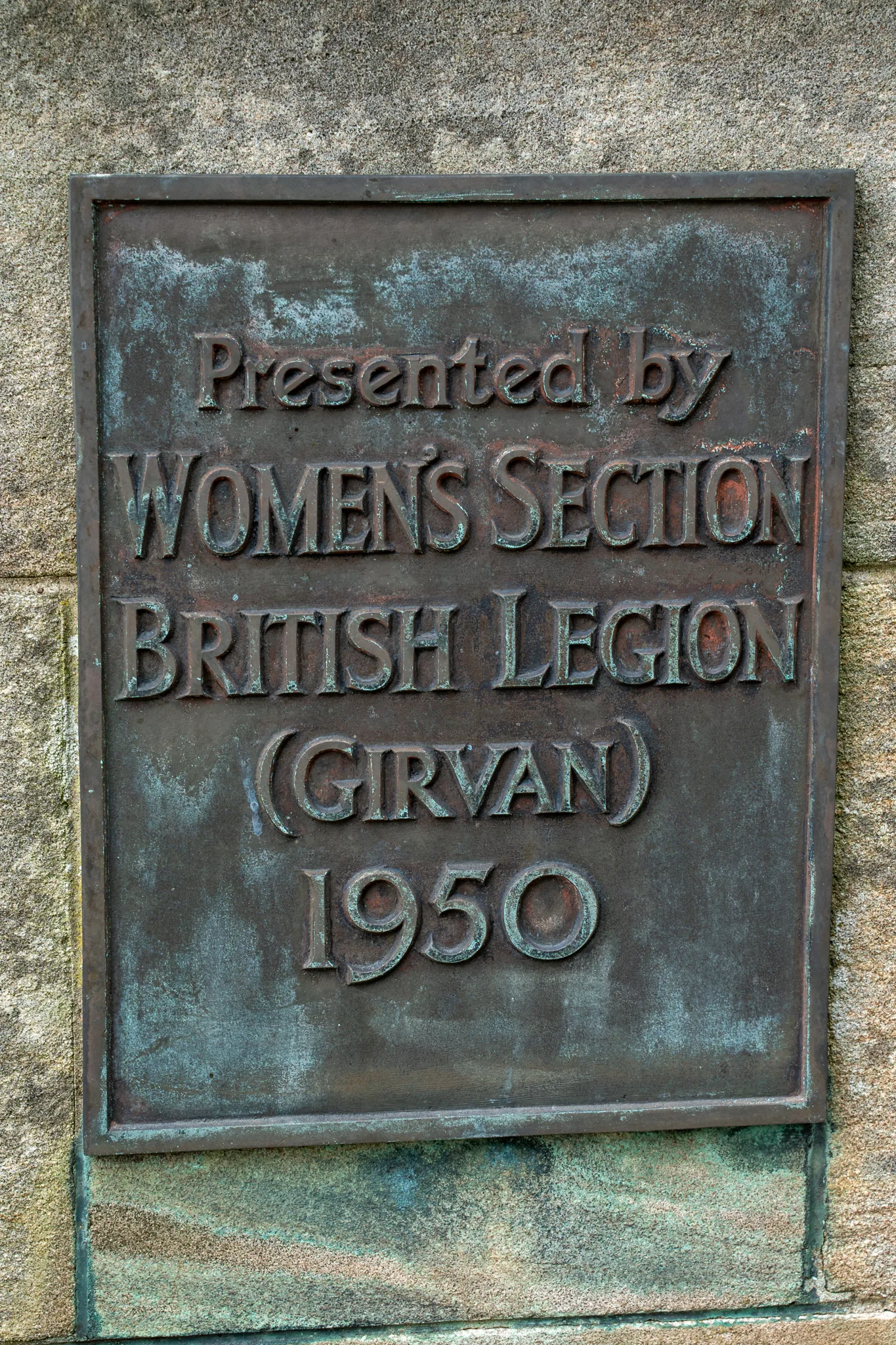
The presentation inscription names the local organisation behind the gift: “Presented by / WOMEN’S SECTION / BRITISH LEGION / (GIRVAN) / 1950.” Five years after the war ended, the Girvan women's gift gave remembrance a place beside the town's gardens.[2]
Their work extended beyond this enclosure. On 21 May 1951, the Glasgow Herald reported that the women's section of the Girvan branch had won the Haig Cup for the fifth successive year. The award went to the Scottish branch raising the largest amount of money for war charities. It places the garden's presentation within a period of sustained charitable work by the Girvan women.[7]
Through the entrance
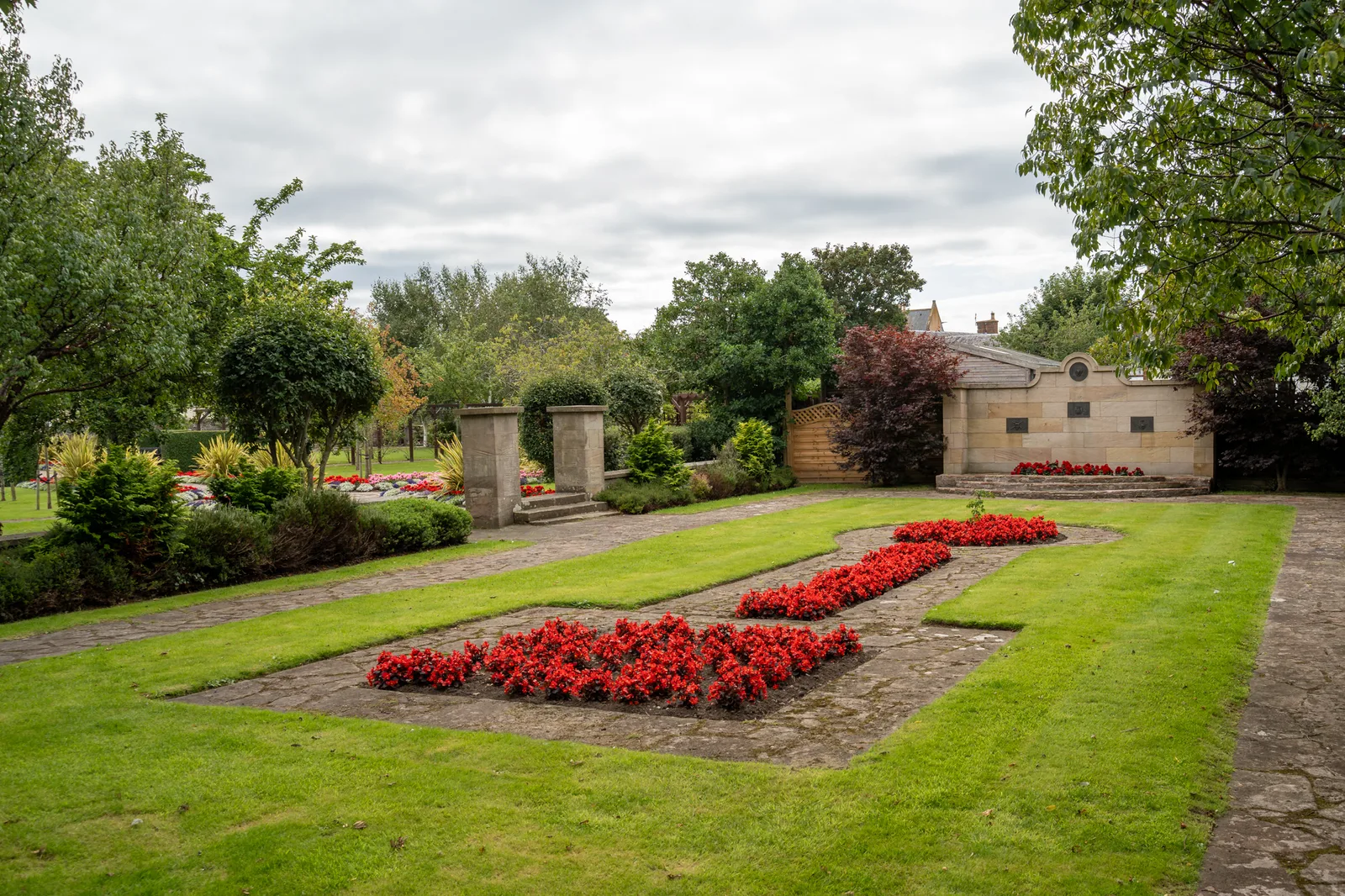
The neighbouring spaces remain distinct. Within the Garden of Remembrance, a stone wall carries service emblems above a semicircle of steps and a flower bed. Lawns and red planting fill the enclosure. Through the entrance, the borders of Orchard Gardens are visible again.
The old map, the presentation plaque and the newspaper notice each add something to this short walk: the ordered planting beside Bank Street, the Women's Section's gift, and the Sunday in June when the remembrance garden was dedicated. Beyond the entrance, the main path leads back between the flowers and trees to The Avenue.
References
[1] Paisley Daily Express, 26 June 1950, p. 3, first column near foot, short notice beginning “When a garden of remembrance”.
[2] Presentation plaque and owner photographs of both gardens. War Memorials Online record.
[3] Ordnance Survey, Girvan Sheet LV.4.18, surveyed 1857, published 1859. National Library of Scotland town plan.
[4] Ordnance Survey, Ayrshire LV.4 (Girvan), surveyed 1856, published 1857. National Library of Scotland.
[5] Ordnance Survey, Ayrshire LV.NE, revised 1894, published 1897. National Library of Scotland.
[6] William Taylor, “It’s fun for all the family”, Daily Record, 13 April 1960, pp. 14–15; Orchard Gardens in the concluding paragraph on p. 15.
[7] “Girvan Women’s Achievement”, The Glasgow Herald, 21 May 1951, p. 6, first column.
[8] Young–Carmichael marriage notice, Times of India, 3 April 1935, p. 2, column 3; and Young birth notice, The Scotsman, 4 August 1937, p. 20, column 6.
Image credits and enquiries
Photographs: Owner photograph. Map detail: Ordnance Survey; reproduced with the permission of the National Library of Scotland. CC-BY reuse information.
Images are included to illustrate Girvan and Carrick’s history for educational purposes. Sources and photographers are credited where known. If you hold rights in an image, please contact us so we can review its use, correct the credit or remove it.
Pass the story on