Medieval Carrick
Four words that put Robert Bruce in Girvan
Key dates
- July 1323
Bruce confirms obligations to attend the head court of Girvan.
- 1328
The peace of Edinburgh–Northampton recognises Scotland’s independence.
- 6 February 1329
Three royal acts are dated at Girvan.
- 7 June 1329
Robert the Bruce dies at Cardross.
Show all 6 dates Show fewer dates
- 1540
A hearing at Knockcushan is recorded in a later royal grant.
- 1683–1722
Abercrummie’s account describes Carrick’s head court at Knockoshin.
Apud Gervan in Carrick.
At Girvan in Carrick.
These four words appear in a royal document issued on 6 February 1329. Robert the Bruce was in Girvan conducting the business of his kingdom: providing for the Blackfriars at Ayr, instructing his chamberlain and confirming the liberties of Aberdeen.[1]
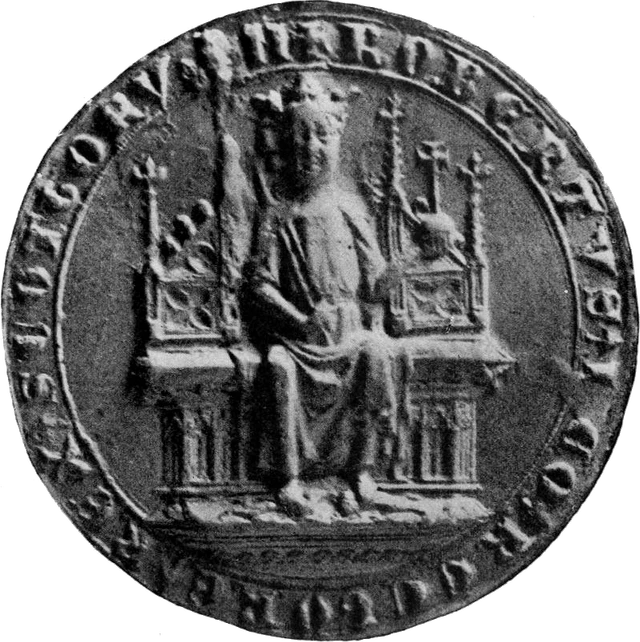
In the last four months of his life, the king was travelling through the country of his family. The business he conducted here reached from Carrick to the north-east coast of Scotland.
The business of a kingdom
The Friars Preachers at Ayr were Dominicans, also known as Blackfriars. Robert assigned them twenty pounds sterling a year from the revenues of his burgh and mills at Ayr, to maintain their church and buildings. The grant created an enduring obligation. A separate mandate instructed the chamberlain, the senior officer responsible for royal finance, to make the payment.[1]
The charter gave the friars a right to the income; the mandate told the officer responsible to pay it. The grant bound piety to accounting.
The charter has suffered badly. When R. W. Cochran-Patrick published it in 1881, he described a torn document with only a small portion of the Great Seal remaining. Some missing words could be recovered from David II’s later confirmation, which repeated his father’s grant. The charter, the payment order and the confirmation preserve its legal life across two reigns.[2]
Aberdeen’s business was different. Its Girvan-dated charter confirmed the burgh’s liberties and powers. Taken together, the three acts show the reach of the government travelling with Robert: affairs from Ayr and Aberdeen could be settled in Carrick.[1]
His last journey south-west
Carrick was Robert’s maternal inheritance. His mother, Marjorie, was its countess, and he had been Earl of Carrick before becoming king. Turnberry was the principal family seat. Returning to this coast meant returning to a country where his authority and relationships had roots older than his crown.[1]
By February 1329 the peace of Edinburgh–Northampton had already been agreed. The settlement of 1328 recognised Robert’s kingship and Scotland’s independence. The Girvan visit belongs to the following winter, after that achievement and shortly before his death at Cardross on 7 June 1329.[1]
The journey can be followed through the records of government and household expenditure. The accounts name Glenkill in Arran, where wine was supplied for the king’s Christmas. They record supplies and the construction of houses at Inchmichael in Galloway. The dated acts trace royal business through Turnberry, Girvan and Carleton, then into Galloway, reaching Whithorn in early April.[1][3]
Girvan belongs to this connected journey. Read alongside the accounts, the dated acts place Robert and his travelling government in Carrick and Galloway during these months.[1][3][4]
Whithorn, with its shrine of St Ninian, gave the journey a religious destination. Along the way, Robert’s grants strengthened relationships with families in the south-west and western Highlands and islands. Devotion and royal business belonged to the same journey.[4]
Fifteen days after the Girvan acts, a separate grant for the Ayr friars was dated at Inchmichael. It allowed them to grind their corn at the king’s Ayr mills without paying multure, the milling charge, and gave their corn priority. The same community benefited from successive decisions as the royal government moved through the south-west.[1]
Girvan’s head courts
Girvan was already a court place during Bruce’s lifetime. In July 1323, at Scone, he confirmed an earlier charter by his brother Edward to John de Carleton. Among its obligations were three annual appearances at the head pleas of the court of Girvan. A head court was one of the principal, regularly appointed sittings at which those owing attendance were required to appear.[1]
Later grants carried the same kind of obligation: three annual suits at the Carrick head courts at Girvan for Gawane Kennedy of Blairquhan in 1505, and another Girvan court-suit clause in 1530.[5]
More than two centuries after Bruce’s visit, a particular case brings the court’s business into view. On 12 October 1540, two deputy bailies of Carrick, James Kennedy in Brunstoun and Malcolm M’Crindill, held a court at Knokoschape juxta Garvane — Knokoschape beside Girvan, identified with Knockcushan. They dealt with money received by John Bard of Kilhenzie from the late Thomas Corry of Keldwood: two thousand merks, delivered in a box.[5]
The proceedings formed part of a debt recovery. The subsequent record lists goods valued towards payment, including oxen, cows, horses, sheep, grain, beds and eight silver spoons. A later appraisal of the Kilhenzie lands took place at Maybole in March 1542, followed by a royal grant that June. It is that grant which preserves the account of the earlier Knockcushan hearing.[5]
Knockcushan and the royal visit
The minister of Maybole, Mr Abercrummie, described Carrick’s courts in an account written between 1683 and 1722 and later preserved in Macfarlane’s geographical collections. He distinguished the ordinary court, held at Maybole on Thursdays, from the head court, which met at “a little Hillock or Know called Knockoshin” within the ground intended for the new town of Girvan. Its jurisdiction included civil debts and crimes.[6]
The description, the court obligations and the surviving case record establish Knockcushan’s importance in the judicial history of Carrick.
Local tradition places Bruce’s court on the mound. It is a natural association in a town with this history of court business, but the documents of 6 February name Girvan without identifying Knockcushan or a particular hearing. We can place the king in Girvan; his precise seat that day remains unproved.[1]
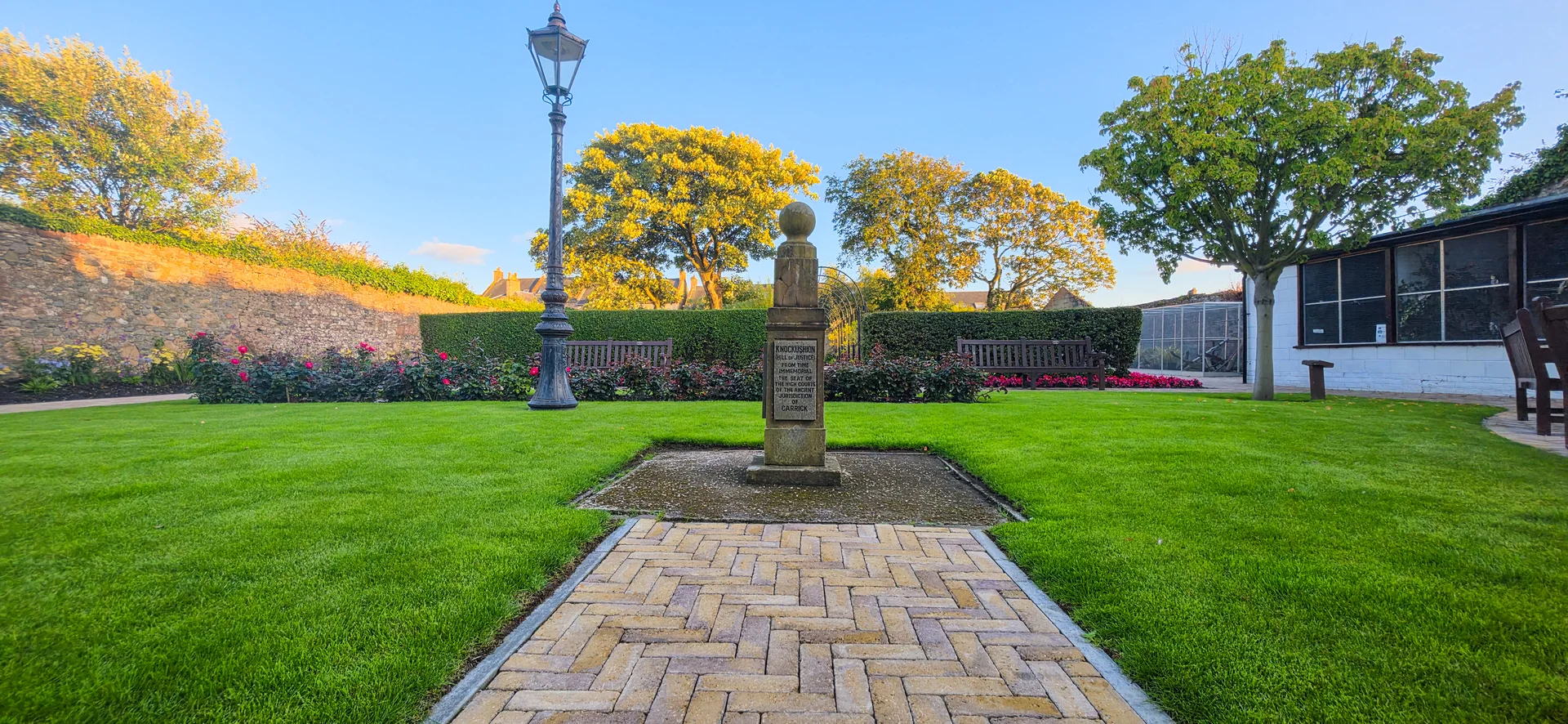
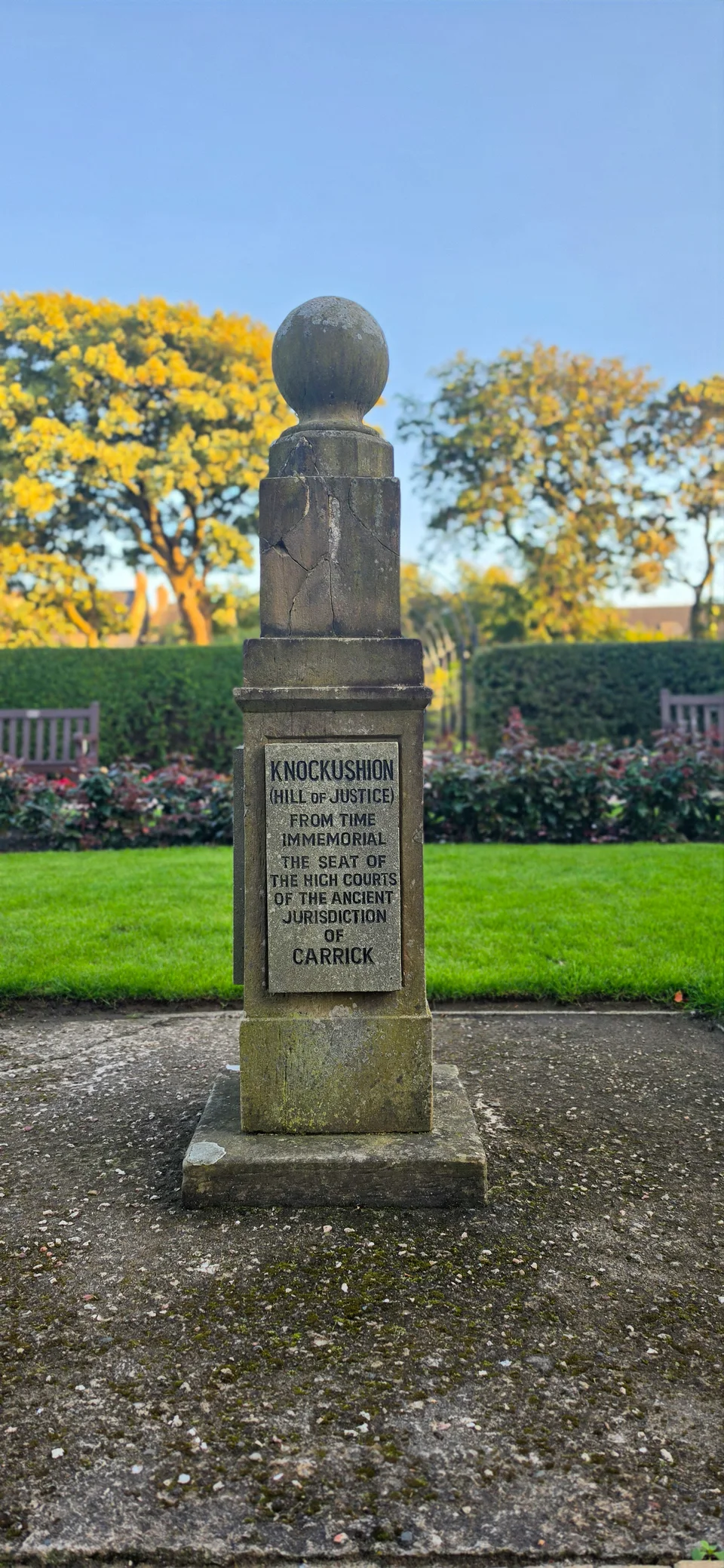
The monument in Knockcushan Gardens commemorates the hill of justice and the high courts of Carrick. The gardens also commemorate Bruce’s visit.
The parchment has been damaged, but the place-name survives. On 6 February 1329, Bruce provided for the friars at Ayr and confirmed the rights of Aberdeen from Girvan. Four words preserve the town’s part in the government of his kingdom: Apud Gervan in Carrick.
References
[1] A. A. M. Duncan (ed.), The Acts of Robert I, King of Scots, 1306–1329, Regesta Regum Scottorum, V (1988), no. 235, pp. 505–506; nos. 362–366, pp. 615–617; no. 368, p. 618; itinerary, pp. 155–157 and notes p. 285. The Girvan acts are dated 6 February in the twenty-third regnal year, calendared 1329. The account of the royal journey follows Duncan’s reconstruction, also adopted by Penman. No. 235 is a Scone confirmation containing an earlier Girvan court clause. Edition details.
[2] R. W. Cochran-Patrick (ed.), Charters of the Friars Preachers of Ayr (1881), nos. 3–5, pp. 3–5, and no. 7, pp. 7–8. Its headings use 1328; the article follows Duncan’s 1329 dating. David II’s confirmation repeats the earlier grant and has its own Ayr dateline. Digitised edition.
[3] The Exchequer Rolls of Scotland, I (1878), pp. 126, 136, 152–153, 162, 191, 196, 201, 213–214, the contemporary accounts used in Duncan’s itinerary. In particular, p. 213 records wine for the king’s Christmas at Glenkill; pp. 152–153 record building at Inchmichael. Bavarian State Library scan.
[4] Michael Penman, “A fell coniuracioun agayn Robert the douchty king: the Soules conspiracy of 1318–1320”, The Innes Review, 50.1 (1999), pp. 25–57, especially pp. 56–57 and note 88. His list of stops includes Girvan; his argument concerns patronage during the final circuit. University of Stirling copy.
[5] Registrum Magni Sigilli Regum Scotorum (Register of the Great Seal), II, no. 2879, p. 612 (2 September 1505); III, no. 896, p. 196 (royal heading 1 February 1529–30, with the inserted charter’s anomalous 3 February 1529 retained in the edition); III, no. 2684, p. 620 (10 June 1542, reciting the court of 12 October 1540). Knokoschape’s identification with Knockcushan follows the local institutional and place-name context. Volume III, p. 620.
[6] Mr Abercrummie, “A Description of Carrict”, in Walter Macfarlane, Geographical Collections Relating to Scotland, II, ed. Sir Arthur Mitchell (Scottish History Society, 1907), p. 16; editorial dating and transmission, pp. xxvi–xxvii. The account is undated: the editor places it between 1683 and 1722. Digitised collection.
Pass the story on